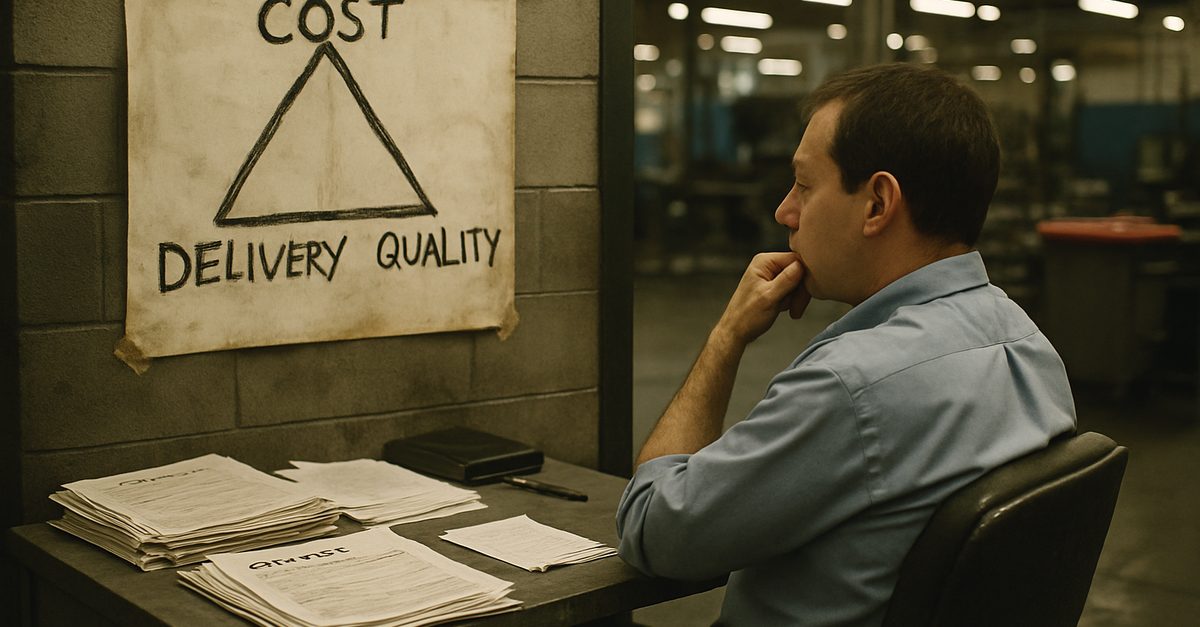
Fast, Good, or Cheap Claim Handling: Which Two Can You Actually Choose?
Fast, good, and cheap claim handling — you get to pick two. Which two you pick should be a deliberate decision based on claim severity, customer exposure, and your team's real capacity. Defaulting to all three is how you end up with a rejected 8D and a furious OEM on the phone.
The "fast, good, cheap — pick two" triangle has been floating around project management circles for decades. Most quality engineers have heard it. Far fewer have stopped to apply it deliberately to claim handling. That's a problem, because every time a customer claim lands on your desk, you're already making that trade-off — whether you realize it or not.
Let's break down what each combination actually looks like in practice, when to use each one, and what happens when you try to cheat the triangle.
What Does the Triangle Actually Mean for a Customer Claim?
Here's the plain version:
Fast — you respond quickly, hit your D3 containment deadline, and get a preliminary 8D to the customer on time.
Good — your root cause analysis is solid, your corrective actions are verified, and the problem actually doesn't come back.
Cheap — you handle the claim with minimal resource spend: small team, no external lab testing, no dedicated task force.
The constraint is real. Compressing cycle time on a root cause analysis without adding resources almost always produces shallow findings. Running a thorough investigation with a full team costs time and money. You can't fully escape the trade-off — you can only manage it.
Option 1 — Fast + Good: When Does This Apply?
This is the right call for high-severity claims: anything that affects vehicle safety, involves a stop-ship from your customer, or carries warranty cost risk above your agreed threshold.
What "fast + good" looks like in practice:
Immediate containment within 24 hours. Sort your warehouse stock, flag any in-transit shipments, and confirm with the customer that no more suspect parts are reaching the line.
Dedicated team assigned the same day. Not whoever is free — the right people. Your process engineer, a production supervisor, and if needed, someone from your Tier 2 supplier.
Structured 8D report started at D0, not D4. Skipping the early D-steps because you're in a hurry is exactly why so many 8Ds get rejected. Document what you know now, even if it's incomplete.
Daily updates to the customer. Even a two-line email saying "investigation ongoing, no new escapes confirmed" keeps the relationship from deteriorating.
Lab testing or measurement authorized immediately. Don't wait for the weekly budget review. The cost of a rejected corrective action is higher than the lab bill.
The trade-off you're accepting: this approach costs money. Extra labor, possible overtime, expedited testing. That's the cost of protecting your customer scorecard and avoiding a formal supplier quality escalation.
Worth it? Almost always, yes — especially if you're already managing PPM pressure. See How to Reduce Customer PPM in Automotive: A Step-by-Step Guide for Suppliers for context on why a single mishandled claim can spike your PPM numbers for a full quarter.
Option 2 — Fast + Cheap: When Is This Tempting, and Why Does It Usually Backfire?
This is the most common default when a claim drops on a Friday afternoon. Minimal team, quick visual inspection, standard containment response, a three-line root cause that says "operator error" or "incoming material nonconformance." Ship the 8D. Move on.
We've all been there. The pressure is real.
The problem: fast + cheap produces a superficial investigation. Your corrective action might close the claim — until the same defect returns two months later. Now you have a repeat claim, a second 8D, and a customer questioning whether your quality system is functional at all.
The 5 Whys method, done properly, takes time. If you're rushing through it in 20 minutes with one person, you're not doing root cause analysis — you're writing a story that fits the facts you already have. That's confirmation bias dressed up as structured problem-solving.
Fast + cheap is occasionally acceptable for low-risk, low-visibility claims — a minor cosmetic reject with no safety or functional impact, where the customer just needs documentation. In those cases, a proportionate response is fine. The mistake is applying this mode to claims that deserve more.
Curious why customers push back so hard on shallow investigations? The 5 Reasons Your Customer Keeps Rejecting Your 8D covers exactly this pattern.
Option 3 — Good + Cheap: Is This Actually Achievable?
This is the slow-burn option. Thorough investigation, solid corrective actions, minimal external spend — but it takes time. In a mature quality system with experienced engineers and solid FMEA documentation, this is genuinely possible for lower-urgency claims.
What it requires:
A team that already knows the process well enough to investigate without scrambling for basic data.
Historical PPAP documentation that's actually current and useful — not a binder that was filed and forgotten.
A customer relationship with enough trust that a longer response window is negotiable.
No active containment risk — meaning the defective parts are already isolated and there's no ongoing escape.
The honest reality: most Tier 1 suppliers don't operate in conditions where good + cheap is consistently available. Team bandwidth is tight, documentation is patchy, and customers want preliminary responses in 24 hours regardless of claim severity. Good + cheap is the aspiration. It's what you're working toward by building better systems — but it's not your default emergency mode.
How to Decide Which Two to Pick: A Practical Decision Framework
When a claim hits your inbox, run through these questions before assigning resources:
Is there an active escape? Parts still reaching the customer line, or already in vehicles? If yes — fast + good, no discussion. Containment is non-negotiable.
What's the customer's response deadline? 24 hours? 5 days? 30 days? Your timeline shapes the resource equation immediately.
Is this a repeat failure mode? If this defect has appeared before, a cheap investigation will not satisfy anyone. You need good — and you probably need fast too.
What's the financial and scorecard exposure? High warranty cost potential, stop-ship risk, or a customer audit on the horizon? Spend the resources now.
Do you have an engineer who actually knows this process? Assigning someone unfamiliar with the line to save labor cost usually produces a slower investigation anyway. That's a false economy.
Document this decision. Not formally — even a quick note in your claim management system that says "fast + good selected, justification: active escape, customer audit scheduled" gives you a paper trail and focuses the team.
What Happens When You Try to Pick All Three?
You get a mediocre claim response that satisfies no one. The containment is technically in place but not verified. The root cause analysis is plausible but not proven. The corrective action is implemented on paper but not sustained. And the cost ends up being higher than either of the two-option combinations — because you'll redo the work when the claim comes back.
This is the real risk of treating the triangle as something you can outsmart. The iron constraint isn't a management theory. It's a reflection of how problem-solving actually works: depth takes time or money. Speed takes resources or sacrifices depth. You're always trading something.
For 0 km claims specifically, where the pressure to respond instantly is highest, this trade-off becomes even more acute. Is 0 PPM for 0 km Claims Actually Achievable? is worth reading alongside this post — the two discussions are directly connected.
Building Toward a System Where Good + Cheap Becomes More Accessible
The long-term goal isn't to get better at picking two. It's to build the process maturity that makes "good" cheaper and faster to achieve. That means:
Current, useful FMEAs. Not documents created for PPAP approval and then shelved. Living documents that your team actually references during investigations.
Trained engineers who can run a real 5 Whys. The method is simple. Doing it well — without stopping at the first plausible answer — takes practice and discipline.
Standard containment procedures that don't require reinvention every time. If your team has to figure out the containment process from scratch on each claim, you're adding hours to every response.
A complaint history that's actually searchable. Repeat failure modes shouldn't surprise you. If they do, your knowledge management has a gap.
None of this is revolutionary. All of it requires sustained effort. That's why most suppliers haven't done it — not because they don't know, but because daily production pressure crowds out systemic improvement. A quality engineer's job, in part, is to make the case that this investment pays back.
FAQ: Fast, Good, Cheap Claim Handling
What does 'fast, good, cheap — pick two' mean in claim handling?
It's a project-management constraint applied to quality claims: you can optimize for speed, thoroughness, or low cost, but rarely all three at once. Trying to hit all three usually means failing at all three.
Which two options should a supplier choose for a warranty or 0 km claim?
For high-visibility warranty claims, 'fast + good' is almost always the right call. Missing a containment deadline costs far more than the extra resource spend.
Can you ever achieve all three — fast, good, and cheap — in claim handling?
Rarely. With mature processes, strong FMEA coverage, and a trained team, you can get close — but it requires upfront investment that most suppliers haven't made yet.
How does choosing 'cheap + fast' affect your 8D report quality?
It almost always produces a shallow root cause analysis. Customers reject these 8Ds because the corrective actions don't hold. You end up spending more time re-doing it than you saved cutting corners.
What's the first step when a customer claim lands on your desk?
Containment first — always. Before you decide which two to pick, you must stop the bleeding. That means isolating suspect parts, checking your stock and in-transit inventory, and notifying the customer within the agreed window.
Related reading
Next step: Get an independent expert review of your 8D report before you submit it