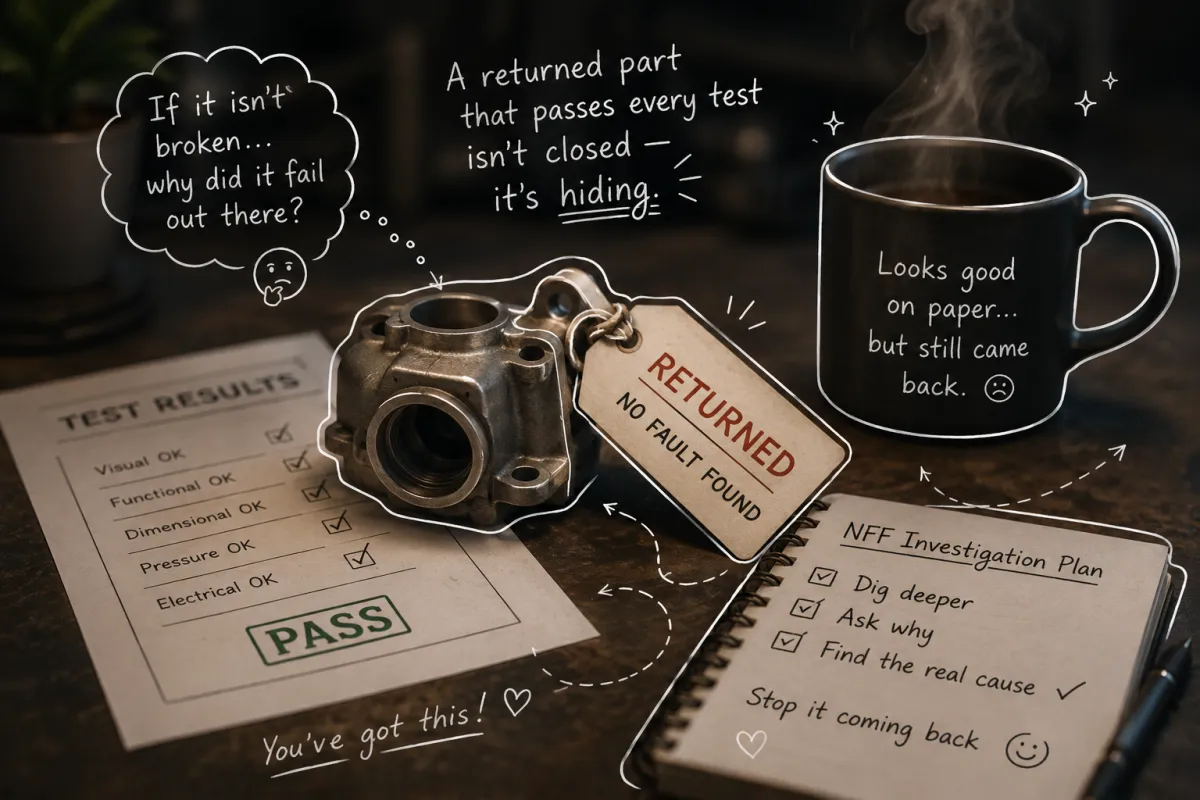
No Fault Found: The Customer Claim Where Nothing Is Wrong
A no fault found return is the claim that drives quality engineers crazy: the customer sends the part back, You test it, and it works perfectly. NFF does not mean there was no problem. It means the problem is hiding from Your test. Here is how to investigate a no fault found return without blaming the customer or closing on a guess.
The claim that makes no sense
No fault found is the strangest customer claim You will handle. The part comes back marked defective, the customer is angry, and on Your bench it passes every test. Everything is in spec. The dimension is good, the function works, the visual is clean. And yet it failed at the customer.
If You work in quality, You know the temptation here. Write "no fault found," send it back, close the case. It is fine, normal to feel this — the data is on Your side. But NFF is not a root cause. It is a confession that Your investigation did not reproduce the customer's condition.
I learned this the hard way over 20+ years. Every "no fault found" I closed too fast came back a second time, louder. The customer does not accept "we found nothing," because from their seat, the part clearly did something.
What "no fault found" actually means
No fault found means one thing: the defect exists in a condition Your test does not cover. The part is fine on Your bench and not fine in the customer's process. The gap is between the two environments, not inside the part.
Think about what is different. Your test is at room temperature, the customer runs hot. Your test checks one part alone, the customer assembles it with five others. Your test is static, the customer's application vibrates. The defect lives in that difference.
So the real question is never "is the part good?" The real question is "under what condition does this good part fail?" When You change the question, the investigation finally starts moving. This is exactly the kind of shallow-versus-deep investigation trap I wrote about in why quality control breaks down.
Why NFF returns are so expensive
No fault found returns cost more than normal claims, and the cost is hidden. Every NFF part gets handled twice, shipped twice, tested twice, and documented twice. The customer loses trust each time one comes back with "nothing found."
Here is my personal experience. We had a batch of connectors returned as intermittent failures. On the bench, perfect. We closed NFF. They came back. We closed NFF again. By the third round the customer put us on elevated inspection and started asking for a new supplier quote. The parts were never the whole story — the real cost was the relationship, and it was draining every week we said "no fault found."
The lesson: an unexplained NFF is not a closed claim, it is an open risk sitting quietly. It always returns, and it returns more expensive.
How to investigate without reproducing on the bench
You cannot fix what You cannot see, so the first job is to make the defect appear. Do not investigate the part — investigate the difference between Your test and the customer's use.
Make a simple two-column list. Left column: exactly how You test. Right column: exactly how the customer uses the part. Temperature, load, cycles, assembly, handling, storage time, orientation. Then hunt for every row where the two columns differ. Each difference is a suspect condition.
Now recreate the customer's condition on Your side, one difference at a time. Heat it, vibrate it, assemble it in the mating part, age it. This is the same discipline as proper root cause verification — You are trying to turn the defect on, not prove it does not exist. When the part finally fails on Your bench, You have found the missing condition, and the NFF disappears.
Get the failure story from the customer
The fastest way to close a no fault found return is to stop guessing and ask the customer for the exact moment of failure. Most NFF cases stay open because nobody asked the right questions.
Ask three things. When exactly did it fail — incoming, on the line, or at the end user? What was the part doing at that moment? And can they send the actual failed sample, not a random one from the same lot? The failed sample is gold, because it may carry the evidence Your good samples never will.
Do you think the customer will refuse to help? Answer is usually NO. Customers cooperate when they see You investigating seriously instead of defending. A structured request for failure data changes the whole tone of the claim. If You want a repeatable way to structure these questions, my AI Quality Claim Agent prompt builds the failure-condition questions for You before You reply.
When the fault is real but intermittent
Sometimes the defect is real, rare, and intermittent — it appears in 1 part per 1000, only under a specific condition. This is the hardest NFF, because Your sample of ten good parts will never show it. Statistics are against You.
For intermittent faults, stop testing a few parts many times and start testing many parts once, under the suspect condition. Widen the sample, tighten the condition. If the customer sees it at temperature, test a hundred parts hot, not five parts hot ten times. The rare defect needs volume to appear.
And be honest in the report. "Fault confirmed as intermittent, occurs under condition X at rate Y, contained by action Z" is a real 8D. "No fault found" is not. One protects the customer, the other just postpones the next return.
Conclusion
Three things to keep. No fault found is never a root cause — it means the defect is hiding in a condition Your test misses. Investigate the difference between Your test and the customer's use, not the part alone. And always ask for the exact failure story and the actual failed sample.
If You have an NFF return bouncing back right now, book a 45-minute session — describe the case and we find the missing condition together. For 8D templates and claim tools that make this repeatable, the tools are here.
Find the condition, not the excuse. Simple, yes, but it is really working.
FAQ
What does no fault found (NFF) mean in manufacturing?
No fault found means a returned part passes all Your tests and appears fully in spec, even though the customer reported a failure. It is not a root cause. It usually means the defect only appears under a condition Your test does not reproduce, such as temperature, vibration, or assembly.
Is "no fault found" an acceptable 8D conclusion?
No. Customers rarely accept NFF because the part clearly failed in their process. A proper 8D must either reproduce the failure under the customer's condition or confirm and contain an intermittent fault with data. NFF alone means the investigation is incomplete.
How do I reproduce a customer failure I cannot see on the bench?
List exactly how You test versus exactly how the customer uses the part, then recreate each difference one at a time — temperature, load, cycles, mating parts, aging. The defect lives in the difference between the two environments, not in the part alone.
Why do no fault found returns keep coming back?
Because closing NFF does not remove the defect, it only postpones the return. The condition that causes the failure is still present in the customer's process. Each return costs handling, shipping, testing and, most of all, customer trust.
What should I ask the customer about an NFF return?
Ask when exactly the part failed, what it was doing at that moment, and whether they can send the actual failed sample. The failed sample often carries evidence Your good parts never will, and the failure story points directly at the missing test condition.
Related reading
Next step: Get an independent expert review of your 8D report before you submit it