
Quality Control in Manufacturing: Why It Breaks Down - and What You Can Actually Do About It
Here’s an uncomfortable truth about manufacturing: most quality problems don’t happen because people don’t care. They happen because the system doesn’t give anyone a real chance to catch the problem in time. If you’ve ever watched an entire batch go back to the customer, you know exactly what I mean.
This isn’t a textbook rundown of ISO standards. It’s about building a quality control system that actually works with a small team and limited resources – one that lives in the real world, not just on paper.
One of the most common beliefs you hear on the shop floor is: “our people are careful, we don’t have quality problems.” Then one day, you do. And it’s not small.
Good intentions don’t equal a system. Human attention is finite – especially at the end of an eight or ten-hour shift, or when three machines are running and one of them is beeping. If quality control depends entirely on someone being alert at the right moment, it will fail eventually.
The reality is that most manufacturing operations treat quality reactively – meaning it only kicks in after something has already gone wrong. The proactive approach is the opposite: built-in checkpoints where a problem can still be caught and fixed before it causes real damage.
The Three Most Common Causes of Defects
Looking back at what I’ve seen across small and mid-sized production facilities, three things show up over and over as the root of most quality problems.
1. No Defined Inspection Point
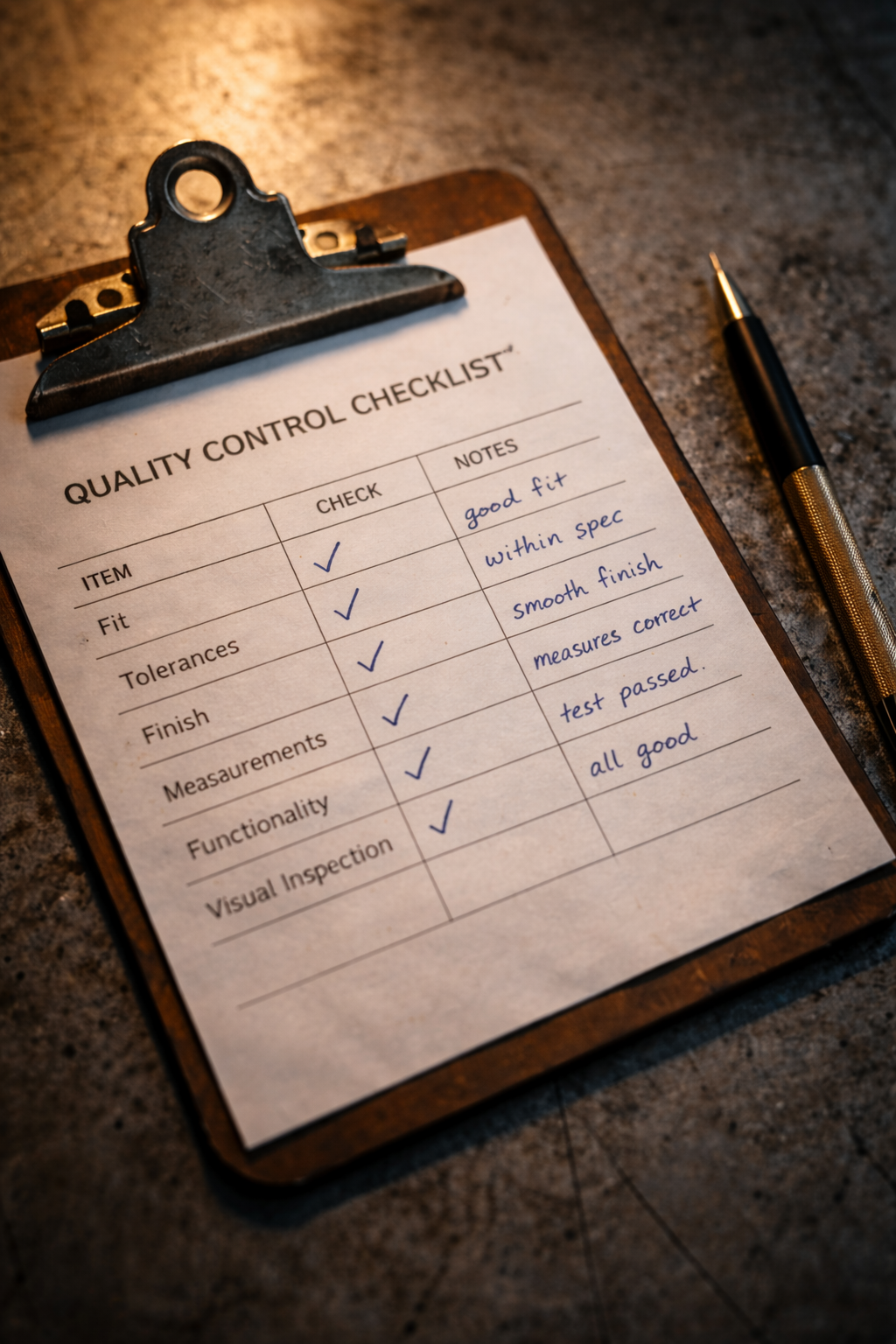
People know what to check – but when matters just as much. If inspection only happens at the end of the process, mid-process errors have already been baked into the product. A simple checklist covering which stage of production requires what kind of check goes a long way.
2. Defects Aren’t Recorded
If a machine repeatedly produces the same type of error and nobody writes it down, you’re left with rumors instead of data. Next week everyone will be just as surprised. A basic defect log – even handwritten – shows the patterns.
3. Feedback Doesn’t Travel Back to the Source
The warehouse knows the package arrived damaged. Assembly knows the component doesn’t fit. But that information never makes it back to whoever is running the process. That communication gap is where the most expensive damage accumulates over time.
What a Working System Actually Looks Like in a Small Company
You don’t need to memorize every ISO standard to build something effective. You need three things: structure, consistency, and someone who owns it.
Structurally, the simplest approach is what’s often called gate inspection. You divide the production process into stages, and at the end of each stage there’s a checkpoint – the product only moves forward if it passes. It doesn’t need to be complicated. Sometimes a checkmark on a sheet is enough.
Consistency means this happens the same way every shift, with every operator. That requires a simple, easy-to-follow procedure – ideally with visual cues like photos, markings on machines, or warning signs at the right spots.
Ownership is the hardest part. In small companies, everyone is responsible for everything – which in practice means no one is truly responsible for anything. Assigning a named owner to each area or checkpoint, even if it’s just one person per zone, changes the dynamic completely.
The Numbers That Make the Case
According to ASQ (the American Society for Quality), the cost of fixing a defect caught early in the production process can be ten times lower than fixing the same defect after it reaches the customer. A mistake caught at assembly might cost you a few minutes of rework. The same mistake discovered when a customer calls – that’s the full cost of the part, the labor, the return shipping, and whatever goodwill you lose in the process.
That’s not meant to scare anyone. It’s just math. And it’s usually the argument that convinces management to invest in quality checks even when resources are tight.
If you find these kinds of posts useful, I send similar ones every month on manufacturing, quality, and operations topics – subscribe below, no spam, just content worth reading.
One Step You Can Take Today
If you had to pick one thing to do right now, make it this: pull up your last three customer complaints and figure out where in the production process the defect actually originated. Not where it was noticed – where it was created. If it’s always the same point, that’s where your first inspection checkpoint should go.
You don’t have to redesign everything at once. One well-placed checkpoint that runs consistently produces more value than ten policies that exist only in a binder.
The Main Takeaway
Quality control isn’t a luxury, and it’s not just for large operations. For smaller companies, it matters more – because one poorly handled problem takes up a much bigger share of your total capacity. Building the system doesn’t have to take months. But it has to start somewhere.
If this was useful and you’d like to read more on manufacturing challenges, complaint handling, and how teams maintain quality without a dedicated department – subscribe to my monthly emails below. A few practical posts per month, nothing more.
Related reading
Next step: Download the free 8D problem-solving guide