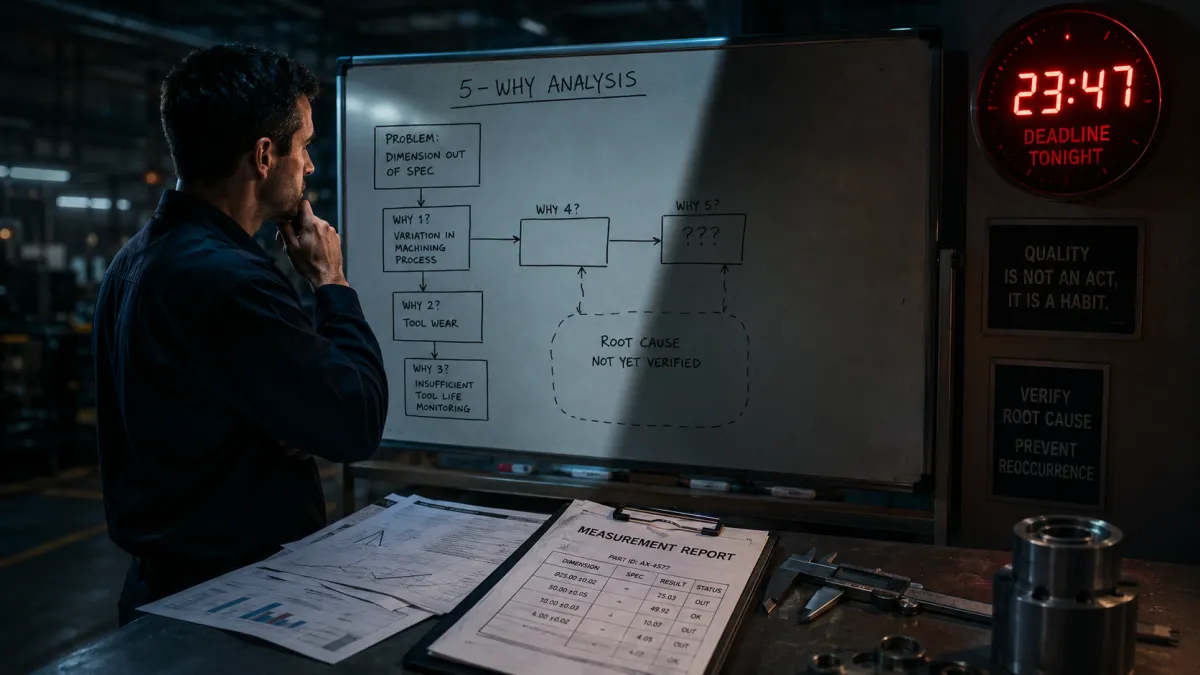
The 24-Hour Claim Deadline: Fast Investigation Without Guesswork
The most common root cause analysis mistakes happen in the first 24 hours, when the customer pushes for a fast answer. Teams verify the first cause that looks logical and close the investigation. The 8D looks complete, the problem returns. Speed pressure is real, but a rushed D4 is the most expensive shortcut in problem solving.
The pressure to answer fast
If You work in manufacturing quality, You know this situation. The customer claim arrives Monday morning, and by Monday afternoon someone from management is asking: "So, what was the root cause?" One day. That is how much time many teams give themselves before the root cause analysis mistakes start.
I lived this many times in my 20+ years in manufacturing. The pressure is not imaginary. The customer wants the 8D in 10 days, production wants the line released, and Your manager wants to write something reassuring in the reply email.
It is fine, normal, all of us felt this pressure. But here is the thing: the speed of Your answer and the speed of Your investigation are two different topics. You can answer fast without investigating fast. Most teams mix these up, and that mistake costs more than any deadline.
What a rushed investigation looks like
A rushed investigation has a recognisable shape. The team meets once, somebody proposes a cause that sounds reasonable, everybody nods, and the 5 Why is written backwards from that conclusion. No data, no part inspection, no process walk. The whole D4 is done in one meeting.
Do you think this is rare? Answer is NO. When leadership celebrates speed over substance, teams learn to deliver fast conclusions instead of verified ones - a pattern factory leaders get wrong about root cause analysis again and again.
The result looks professional. The 8D template is filled, the arrows point in the right direction, the corrective action is assigned. But underneath, it is a guess with good formatting. And a guess does not stop a problem from coming back.
The first logical cause is rarely the root cause
Here is my personal experience with this. Years ago we had a claim for a dimensional defect, and on day one the team concluded: operator error. The operator loaded the part wrong. Retraining was assigned, the 8D was nearly closed.
Two weeks later we found the real cause in a tool wear pattern. The tool was drifting slowly out of tolerance, and the "wrong loading" was the operator compensating for parts that already did not fit. If we had closed on day one, we would have retrained an innocent person and kept producing defects.
This is the trap of the first logical cause. The structured 8D process exists exactly to prevent teams from jumping to premature conclusions, because the first explanation that fits the symptom is usually the most visible cause, not the deepest one. Blaming a person almost always means You stopped one "why" too early.
How to be fast AND structured
You can satisfy the customer's need for speed without rushing the investigation. The tool for this is the immediate containment action, and it buys You the time D4 needs.
Within 24 hours You should communicate three things: the suspect material is contained, the customer is protected by sorting or inspection, and the investigation is running with a defined timeline. That is a fast answer. Notice that none of it requires knowing the root cause yet.
Make this Your standard structure: containment in 24 hours, verified root cause by D4 deadline, not before. When You separate "protect the customer" from "understand the problem," the pressure on the investigation drops immediately. I wrote more about this balance in time pressure vs. quality in manufacturing.
The data check that takes 30 minutes
Before You accept any proposed cause, run one simple test. Take the cause and ask: if this is true, what should the data show? Then go look.
If the cause is "operator error on night shift," the defects should cluster on night shift. Pull the records. If the cause is "new material batch," check the batch numbers of the NOK parts. This check usually takes 30 minutes, and it kills false causes before they enter the report.
Most root cause analysis mistakes survive because nobody did this half hour of work. A structured tool helps here - this is exactly why I built an AI-guided 5 Why tool, to force the verification question after every "why" instead of letting the chain run on opinion. And be careful with using AI to skip the thinking itself - I explained that risk in this post about AI and critical thinking.
When to push back on the deadline
Sometimes the honest answer is: we do not know yet, and we will not know by Friday. Saying this feels dangerous. Closing with a wrong root cause is more dangerous.
Push back with structure, not with resistance. Show the customer what You verified so far, what is still open, and the exact date of the next update. In my experience, customers accept a delayed root cause with evidence much easier than a fast root cause that fails. A returned claim after a "closed" 8D destroys more trust than one honest extension.
Make this calculation visible to Your management too. A wrong root cause means the claim returns, plus sorting costs, plus a customer who now audits every report You send. The 24-hour root cause is not cheaper. It only moves the bill to next quarter.
Conclusion
Two things to take from this. First: separate the fast answer (containment) from the real answer (verified root cause) - they have different deadlines. Second: every proposed cause gets the 30-minute data check before it enters the report. No exceptions.
If You are sitting on a claim right now and the deadline pressure is on, book an 80-minute Deep Dive - describe Your situation and we structure the investigation together. And if You want templates and guides that make this repeatable, the tools are here.
Slow down the investigation to speed up the closure. Simple, yes, but it is really working.
FAQ
How long should a root cause analysis take?Containment should be done in 24 hours, but a verified root cause typically needs 5 to 15 working days depending on complexity. The customer deadline drives the report date, not the investigation quality. If You need more time, communicate it with evidence of progress.
What is the most common root cause analysis mistake?Accepting the first logical cause without data verification. The team agrees on a plausible explanation in one meeting and writes the 5 Why backwards from it. The fix is simple: every cause must pass a data check before entering the report.
Is operator error a valid root cause?Almost never as a final answer. If an operator made a mistake, ask why the process allowed that mistake and why detection did not catch it. Stopping at the person means the same error will happen again with a different person.
How do I answer the customer before the root cause is found?Send the containment actions, the protection plan for their production, and a dated investigation timeline. Customers mainly need to know their line is safe. A structured interim answer buys time for a proper D4.
Can I speed up root cause analysis without losing accuracy?Yes, by structuring it. Use a disciplined 5 Why or 8D process, run the 30-minute data check on each proposed cause, and work occurrence and detection chains in parallel. Structure removes the wasted loops, not the necessary ones.
Related reading
Next step: Get an independent expert review of your 8D report before you submit it