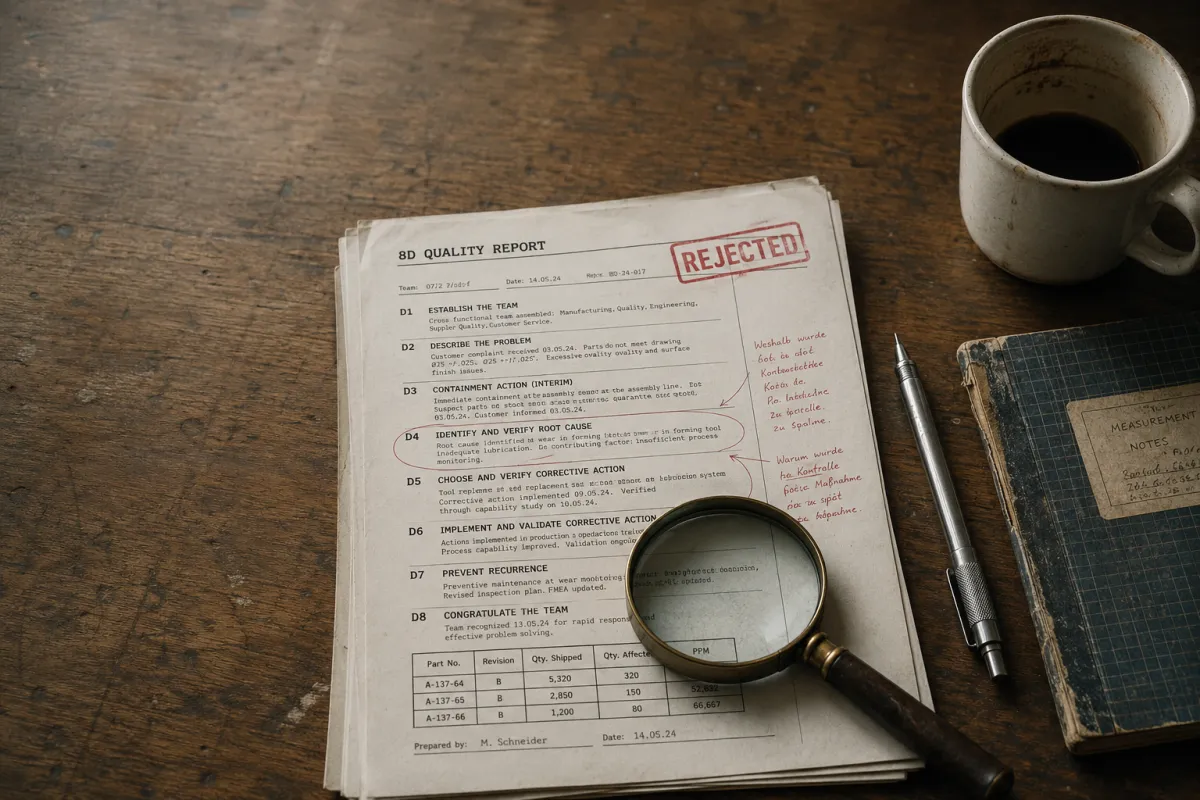
The 5 Reasons Your Customer Keeps Rejecting Your 8D
If you have been doing this work for any real length of time, you know that feeling. The customer is not satisfied. The corrective action did not stick. The report comes back with comments that feel personal even when they are not. You read them at 9 in the morning and you carry them with you to lunch.
I have reviewed more than two hundred 8D reports from suppliers across automotive, electronics, and industrial component manufacturing. Tier 1, Tier 2, Tier 3. Some of them were written by engineers with twenty years of experience. Some by people who had been handed an 8D template the week before. The reports that get rejected over and over share a pattern — and the pattern is almost never what the supplier thinks it is.
It is not the format. It is rarely the language. It is almost never the deadline. There are five reasons the customer keeps sending your 8D back. Most reports that get rejected fail on two of them. Fix the two and the report gets accepted. That is the work.
This post is the field-level breakdown of those five reasons, written for the quality engineer who is the only one in the room. If you want the structured templates and the example reports that go with this, the Free 8D Guide is at the bottom — no email gate beyond a single field, no upsell sequence, just the tools.
1. Your containment is not actually containing.
Containment is the first real test of an 8D, and it is the one most engineers underestimate. D3 is not a checkbox. It is the moment where you tell the customer — in writing — what defective parts cannot reach them anymore, and how you know.
The rejection language usually sounds like this: "Containment plan is not clear. Please define quarantine boundary." Or: "How are sub-suppliers and in-transit material covered?" Or simply: "Insufficient."
What that customer is actually asking — and most quality engineers do not hear it — is this: I am about to keep buying from you for the next four weeks while you investigate. Tell me, exactly, what is going to keep my line running.
A containment that contains has four things:
A defined population (lot numbers, date codes, serial ranges — not "all suspect material")
A defined boundary (at your plant, in transit, at the customer, at sub-suppliers — name all four)
A defined inspection or screening method with a sample size that means something
A defined responsible person and a date — not "quality team" and not "ASAP"
If your D3 fits inside one paragraph, it is almost certainly insufficient. Rewrite it as a list. The customer will read it as evidence that you took the problem seriously.
2. Your root cause is a symptom wearing a costume.
This is the most common reason for rejection across every industry I have worked in. The supplier identifies a "root cause" that is actually one layer too shallow. The customer can see it. The supplier cannot.
Examples of root causes that are not root causes:
"Operator error" — why was the operator able to make the error? Why did the process allow it?
"Machine out of calibration" — why was the calibration missed? What is the system that should have caught it?
"Supplier delivered bad material" — why did your incoming inspection let it through?
"Drawing was wrong" — what is the engineering change process and where did it fail?
A real root cause is something you can put a process control on. If your D4 conclusion is something that could happen again tomorrow with no one breaking any procedure, you are not at root cause yet. You are at a contributing factor with a confident voice.
I had a Tier 2 automotive supplier who submitted three rejected 8Ds in eighteen months for the same warranty defect. Three rejections. Each one named a different "root cause." Operator, then training, then machine maintenance schedule. When we sat down and did a structured re-investigation, the actual root cause was a measurement system error — the gauge they were using to confirm conformance had a 30% repeatability problem nobody had ever quantified. The defect had been passing through the gauge for years. The revised 8D was accepted in five working days. The defect did not recur over the following twelve months.
The 5Why is the tool most engineers reach for here, and it works — when you ask the right questions and stop at the layer that has a process behind it. The DykeArt AI-Guided 5Why Tool was built specifically to keep you honest at each layer. It asks the questions a senior quality manager would ask if they were sitting next to you. (Link at the bottom of this post.)
3. Your verification step is the word "training."
D5 and D6 are about verifying the corrective action. The number of 8Ds I have read where the verification is literally "operators were retrained" or "work instruction was updated" — and that is it — is uncomfortable.
Training is not verification. Training is an action. Verification is the evidence that the action made the problem go away.
A verification step that survives customer review has three parts:
What you measured (defect rate, ppm, first-pass yield, customer return rate)
How long you measured it (one shift is not enough; ideally one full production cycle or one month, whichever is shorter)
What the result was compared to a defined acceptance criterion ("defect rate dropped from 4,200 ppm to 80 ppm over four weeks against a 200 ppm target")
If your verification reads "retraining completed and effective," the customer reads it as "we did not actually measure anything." Add the numbers. If you do not have the numbers, the corrective action is not verified yet — the report is not ready to submit. This is unpopular to hear and almost always true.
4. Your evidence is a screenshot of a screenshot.
Customers reject 8Ds because the evidence section looks like an afterthought. Blurry photos. Pareto charts with no axis labels. Process flow diagrams that someone built in PowerPoint with the default arrows. Excel sheets exported to PDF at the wrong zoom level.
This is the easiest of the five to fix and the one suppliers fix last.
The customer reviewing your 8D is not just looking at the conclusion. They are looking at how you got there. The evidence is the proof of the work. Sloppy evidence reads as sloppy investigation, even if the investigation itself was sound.
Minimum standards for 8D evidence:
Photos: in focus, with date and reference scale, with a one-line caption identifying what is being shown
Charts: axis labels, units, sample size, and the rule that defines a defect
Process flow: minimum-viable, but show the failure point clearly
Tables: sortable in the file you send, not a screenshot of a sortable table
None of this requires extra software. It requires fifteen extra minutes per report. The acceptance rate change is enormous.
5. The tone of the report reads as defensive.
This is the reason nobody talks about in 8D training, and it kills more reports than any of the four above.
The customer rejected your previous report. You are tired. You rewrite the 8D with a small, sharp edge in the language. You explain why the previous root cause was "also valid." You insert a sentence that hints the customer's specification was unclear. You use the passive voice for everything that went wrong on your side and the active voice for everything that went wrong on theirs.
The customer's quality engineer reads it in three minutes and rejects it again. Not for technical content. For tone.
Here is the rule I give to every quality engineer I work with: write the 8D as if you were the customer's quality engineer reading it. If any sentence would make you defensive, rewrite it. Take ownership where ownership is yours. Be specific where you are vague. Be brief where you are repetitive.
A calm 8D from a supplier the customer has been frustrated with does more for the relationship than any corrective action. The 8D is not just a technical document. It is a communication artifact. The companies that get this consistently win contracts at renewal. The companies that do not, lose them.
The pattern: 90% of rejections fail on two of these five.
When I do an 8D review and improvement session for a supplier (it is the €30.99 service on dykeart.net), I score the report against these five categories. The vast majority of rejected 8Ds are weak in exactly two of them — usually root cause and either containment or verification. Strengthen those two and the acceptance rate moves dramatically.
That pattern is what made me write the Free 8D Guide. It walks through each of these five reasons with a real example, the rejection language the customer used, and the rewrite that got the report accepted. Engineers tell me it is the most practical 8D document they have on file. It is free, no upsell sequence.
If you want the AI to walk you through a 5Why investigation the way a senior quality manager would, the AI-Guided 5Why Tool is at https://dykeart.net/product-details/product/69d6929c8da26a05635fd915. It is designed to stop you at the layer where most engineers declare root cause and ask the one more question that usually changes the answer.
And if you have an 8D in front of you right now that has been rejected and you do not know why, send it. The 8D Review will get you a marked-up report with the gap analysis and the rewrite suggestions inside two working days.
Related reading
Next step: Get an independent expert review of your 8D report before you submit it