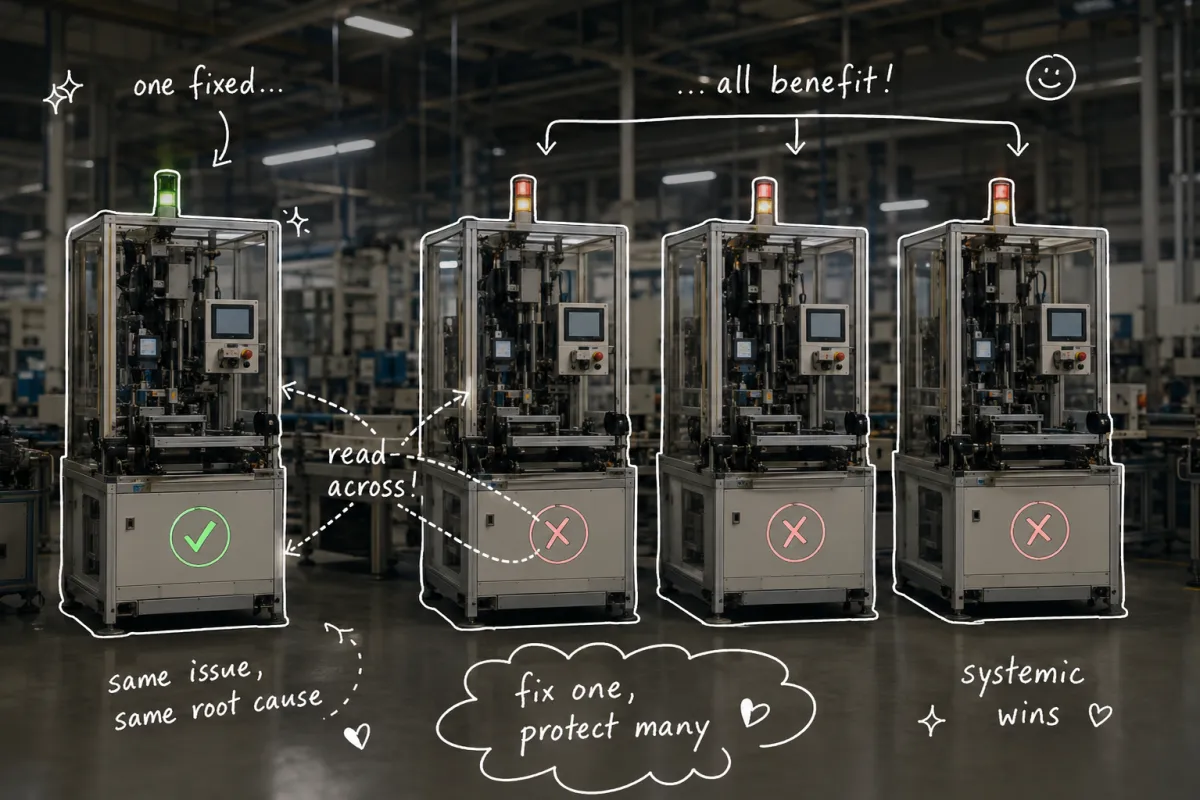
You Fixed One Line. The Same Defect Lives on Five Others.
Read-across is the corrective action step almost everyone skips. You find the defect on one line, fix that line, close the 8D — and the same root cause is still sitting on every other line, machine, and part that shares it. Systemic corrective action means fixing the problem everywhere it can exist, not only where the customer caught it.
The fix that was not really a fix
Read-across is the difference between stopping a defect and stopping this one defect. You solve the claim on line 3, the customer is happy, the 8D is closed. Two months later the same defect appears on line 7, and now You have a second claim for a problem You already "solved."
If You work in quality, this pattern is painfully familiar. The corrective action was real. It just was not applied everywhere the root cause lives. It is fine, normal — under claim pressure You fix where the fire is. But the root cause does not care which line the customer noticed first.
I have seen this cost companies more than the original defect ever did. One verified root cause, fixed in one place, ignored in five others. The claim did not recur because the fix failed. It recurred because the fix was too narrow.
What read-across actually means
Read-across means taking Your verified root cause and asking one question: where else can this exact cause exist? Then applying the corrective action to all of those places, not just the one that generated the claim.
The root cause is almost never unique to one line. If a torque setting was wrong on one station, check every station using that setting. If a supplier's material caused it, check every part number using that material. If a work instruction was unclear, check every operation using that instruction.
This is the systemic part of corrective action that IATF 16949 explicitly expects, and that most rejected reports miss. The customer wants to know You fixed the class of problem, not one instance of it. A systemic corrective action closes every door the same cause could walk through.
Why teams skip it
Read-across gets skipped for three simple reasons, and none of them are laziness. Understanding them helps You build it back in.
First, pressure. The claim is on line 3, so the whole team looks at line 3, closes line 3, and moves to the next fire. Second, ownership. The other lines belong to other people, other shifts, other plants — nobody feels responsible to check them. Third, invisibility. The other lines have not failed yet, so the risk feels theoretical until it becomes the next claim.
Do you think Your team already checks the other lines automatically? Answer is usually NO. Without a written read-across step in the 8D, the investigation naturally stops at the line that failed. This is the same organisational blind spot I described in quality control breaking down — good intentions do not survive the next deadline.
How to run a read-across the simple way
Make read-across a fixed question in Your D6 and D7, not an optional extra. After the root cause is verified, before You close, answer four questions on paper.
Where else is this exact process used? Where else is this material, tool, or setting used? Which other part numbers share this operation? And which other plants or shifts run the same thing? Each "yes" is a place the corrective action must also go. List them, assign them, and put a date next to each.
Keep it concrete. Make the criteria list, put a name and a deadline on every affected location, and treat those actions with the same weight as the original fix. A read-across without owners and dates is just a nice sentence in a report. My Global 8D and 5 Why Training Guide includes a read-across matrix You can drop straight into Your 8D.
The read-across that saved a second claim
Here is my personal experience with this. We had a claim for a missing sealing step on one product. The root cause was a work instruction that did not clearly require the step. Easy fix on that product — update the instruction, retrain, done.
But before closing, we ran the read-across. The same unclear instruction template was used on four other products, all with the same sealing risk. None had failed yet. We fixed all five. Three weeks later, an internal audit found that one of those other four had already shipped borderline parts — parts that would have become the next customer claim. The read-across turned one claim into zero future claims. The original fix alone would have left four loaded guns on the floor.
That is the whole value. Read-across converts a reactive fix into a preventive one, without any new investigation. You already did the hard work of finding the cause — read-across just spends it fully.
Read-across is prevention, and prevention sells
When You present a read-across to a customer, something changes in the relationship. A normal 8D says "we fixed the problem." A read-across 8D says "we fixed the problem and we checked everywhere else it could happen." The second one builds trust that wins the next order.
This matters commercially, not just technically. Customers audit suppliers who keep sending them the same defect from different lines. They expand business with suppliers who visibly think ahead. Read-across is one of the cheapest ways to look like the second kind of supplier, because it uses work You already finished.
So frame it that way internally too. Read-across is not extra cost — it is the cheapest prevention available, built on an investigation You already paid for. Skipping it is the expensive choice, it just sends the bill later.
Conclusion
Three things to keep. A verified root cause almost always exists in more than one place — the claim only shows You the first. Build read-across into D6 and D7 as four fixed questions with owners and dates. And present the read-across to Your customer, because prevention is what earns the next order.
If You just closed an 8D and are not sure You checked everywhere, book an 80-minute Deep Dive — bring the case and we run the read-across together. For the read-across matrix and full 8D templates, everything is here.
Fix it once, everywhere. Simple, yes, but it is really working.
FAQ
What is read-across in corrective action?
Read-across is applying a verified corrective action to every other line, machine, part number, or plant that shares the same root cause — not only the one where the customer found the defect. It turns a local fix into a systemic one and prevents the same problem recurring elsewhere.
Where does read-across fit in the 8D process?
It belongs in D6 (implement corrective actions) and D7 (prevent recurrence). After the root cause is verified, You ask where else the cause can exist and extend the action to all of those places with named owners and deadlines before closing the 8D.
Why do the same defects keep appearing on different lines?
Because the corrective action was applied only where the claim occurred, while the root cause still lives on lines that have not failed yet. Without a read-across step, the investigation naturally stops at the failed line and leaves the others exposed.
How do I decide where to apply read-across?
Ask four questions: where else is this process used, where else is this material or tool or setting used, which other part numbers share this operation, and which other plants or shifts run the same thing. Every yes is a location the corrective action must also cover.
Does read-across count as preventive action?
Yes. Read-across uses an investigation You already completed to stop the same cause before it produces new claims elsewhere. It is one of the lowest-cost forms of prevention because it requires no new root cause analysis, only disciplined application of the fix You already verified.
Related reading
Why Is It So Difficult to Create a Perfect Root Cause Analysis?
Real-Time Quality Data: Catch Defects Before They Become Scrap
Next step: Get an independent expert review of your 8D report before you submit it