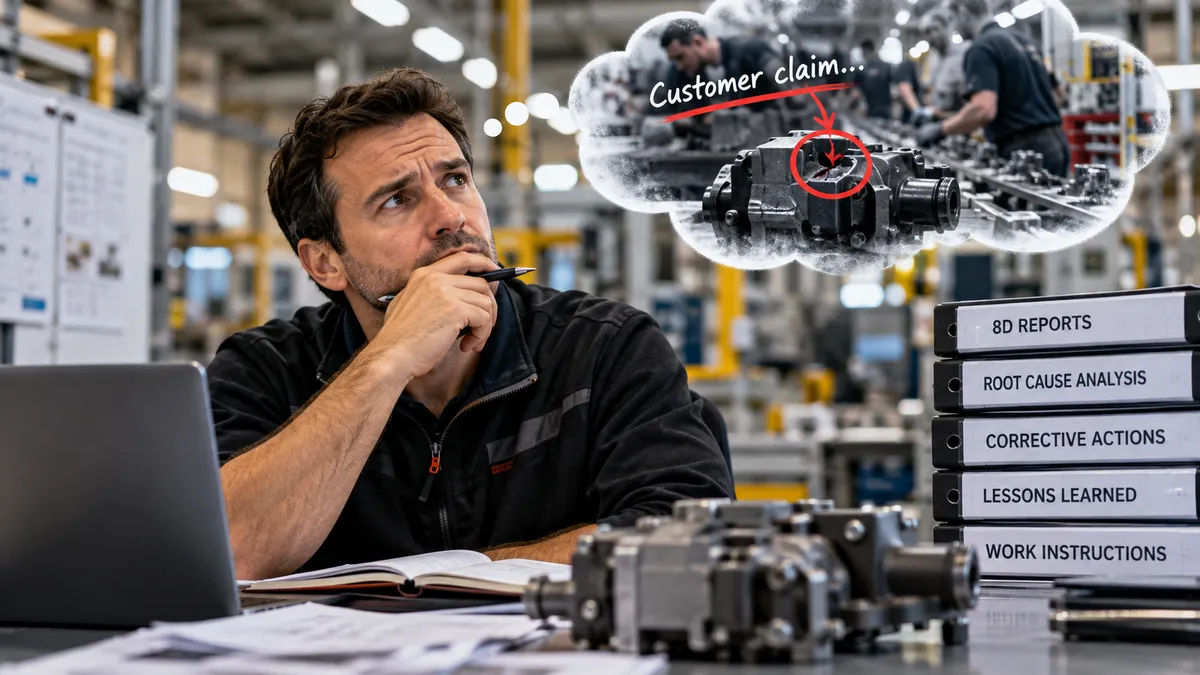
Knowledge management in manufacturing: can it prepare you for any trouble?
Knowledge management in manufacturing: can it prepare you for any trouble?
Training and experience build individual skills, but without structured knowledge management, your team will repeat the same mistakes when trouble hits. A documented, accessible system is what bridges the gap between knowing and doing.
You have trained your engineers. You have years of experience on the floor. Your quality manager knows the process inside and out. So here is the real question: if a major defect escapes to your customer tomorrow morning, is your team actually ready to respond fast and correctly?
Knowledge management is the honest answer to that question. Not the feel-good version of it, but the practical one. This post lays out what that means for a real manufacturing team, what goes wrong without it, and what a working system looks like step by step.
Why does experience alone fail under pressure?
Experience is personal. It lives in someone's head. When that person is on vacation, works the night shift, or leaves for another company, the experience walks out the door with them.
This is not theoretical. Ask any quality engineer who has spent a Friday afternoon trying to find out why a corrective action from three years ago was approved. The engineer who wrote it is gone. The file is on a laptop nobody can log into. The production team is waiting for an answer.
That is a knowledge management failure. Not a training failure. Not a skills gap. The knowledge existed - it just was not stored in a way that anyone could reach it when the pressure was on.
Reality check: training produces capable individuals. Knowledge management produces a capable organization. You need both.
What does knowledge management actually mean on the shop floor?
Strip away the consulting language. On the floor, knowledge management is about three things:
Capturing what you learn. Every defect investigation, every root cause analysis, every corrective action that actually worked. Written down. Stored where people can find it.
Making it accessible. A binder nobody opens is not a knowledge system. Accessibility means your team can retrieve the right information in under five minutes during a production problem.
Keeping it current. A procedure written in 2019 for a machine you replaced in 2022 is worse than useless. It creates false confidence.
That is it. No expensive software required to start. A consistent folder structure and a naming convention will take you further than a complex digital platform that nobody updates.
How does knowledge management connect to quality problem solving?
Every time your team completes an 8D report, they produce a knowledge artifact. The problem description, the root cause, the containment actions, the corrective action, and the verification results are all documented lessons.
If those reports are stored in a searchable format, the next engineer who faces a similar defect can start from D3 instead of D1. That saves hours on containment. It saves days on root cause. When a customer claim is waiting, those hours matter.
If you want a practical starting point, the Free 8D Report Guide with 5 real cases and an Excel template gives you a ready-to-use structure you can drop into your knowledge system immediately. Real cases, not invented scenarios.
Think about recurring defects for a moment. A defect that comes back six months later is almost always a knowledge management problem. The corrective action existed. It worked. But nobody documented it in a form that traveled to the next operator, the next shift, or the next product family. So the team rediscovers the same root cause under the same pressure.
What does a step-by-step knowledge capture process look like?
Here is a process that actually works in mid-size manufacturing. It is not perfect, but it is deployable this week.
Define trigger events. Every customer claim, every internal scrap event above your threshold, and every near-miss gets documented. No exceptions. If it is not a trigger, it is not captured.
Assign a knowledge owner. One person is responsible for making sure the post-investigation summary gets written and filed. Not a committee. One person.
Use a standard template. Same fields every time: problem description, root cause, containment, corrective action, verification result, lessons learned, read-across potential. Consistency is what makes documents searchable later.
File in a shared location with a logical naming convention. Date, part number or process, defect type. Something your newest engineer can decode without asking for help.
Run a monthly 15-minute review. Pull the last month's entries. Flag anything with read-across potential. Update relevant work instructions or control plans before the next production run.
Tie it to onboarding. New engineers and operators review the last 12 months of documented cases for their area before they work independently. This converts institutional memory into transferable knowledge.
This is the step-by-step foundation. You can build complexity on top of it later. You cannot build on nothing.
Do this / avoid that: common knowledge management mistakes
Do this: Write the lessons-learned section of every corrective action in plain language. Assume the reader was not in the room when the problem was investigated.
Avoid that: Writing "operator error" as the root cause and stopping there. It tells the next team nothing actionable and guarantees the defect returns.
Do this: Keep your knowledge repository in the same system your engineers use daily. Documents that live somewhere nobody opens effectively do not exist.
Avoid that: Building a thorough knowledge base that only the quality manager can update. Bottlenecks kill adoption.
Do this: Explicitly document what you tried and failed before finding the real root cause. Failed paths are knowledge too. They save the next team from repeating dead ends.
Avoid that: Deleting draft versions and intermediate findings once the final report is written. Context matters when someone is trying to understand a decision made under time pressure.
Does training actually fill the gap that knowledge management leaves?
Training and knowledge management solve different problems. Training builds capability. Knowledge management builds continuity.
A well-trained engineer with no documented history of past problems will still improvise during a crisis. An average engineer with access to ten years of root cause analyses and corrective actions from similar defects will make better decisions faster.
We explored this tension directly in the post on Internal or external training for engineers: which one actually works? The conclusion there is consistent with what we see here. The format of training matters less than whether the knowledge it creates gets captured and shared after the training ends.
Most companies invest heavily in training and lightly in what happens to that knowledge afterwards. That imbalance is expensive.
What happens to knowledge management during a skilled-labor shortage?
When experienced people leave, knowledge management stops being a nice-to-have. It becomes the only mechanism that keeps quality consistent.
A floor running with new or less-experienced operators is not a doomed floor. It is a floor that needs better documentation, clearer work instructions, and faster access to past defect histories. Knowledge management is how you compensate for reduced experience on the team without compromising output.
The post on Skilled-labor shortage: how to hold quality and throughput on the floor goes into the operational side of this in more detail. The short version: documenting your best operators' tacit knowledge before they retire or resign is the most underused risk-reduction strategy in manufacturing.
How do you know if your knowledge management system is working?
Three signals.
First: Recurring defect rate. If the same defect family reappears on a cycle shorter than 18 months, your corrective actions are not being captured or communicated in a useful form.
Second: Time to containment on new problems. If your team takes longer than four hours to implement containment on a customer claim, part of that delay is usually a search for information that should already be documented.
Third: Onboarding speed. How long does it take a new quality engineer to become independently effective in your environment? If the answer is more than six months, the gap is almost always documentation, not intelligence.
These are not soft metrics. They show up in your PPM, your customer claim frequency, and your scrap rate. Knowledge management is measurable. You are already measuring its failures. You just might not be labeling them correctly.
FAQ
What is knowledge management in manufacturing quality?
It is the practice of capturing, organizing, and making accessible the lessons, procedures, and corrective actions your team has already worked through, so the next engineer does not have to start from zero.
Does training alone prepare a team for quality crises?
Not fully. Training gives individuals skills, but a quality crisis demands fast, coordinated action. Without a system that stores past root causes, containment decisions, and corrective actions, trained people still improvise under pressure.
How does knowledge management connect to 8D problem solving?
Every completed 8D report is a knowledge artifact. When stored and searchable, those reports let your team reuse root cause analysis and corrective actions instead of rediscovering them after each new customer claim.
What is the minimum viable knowledge management system for a small manufacturer?
A shared folder with standardized templates, a log of past defects with root causes and corrective actions, and a brief onboarding checklist. It does not need software. It needs consistency.
How do recurring defects signal a knowledge management failure?
When the same defect reappears months later, it usually means the corrective action was never documented in a reusable format - or the documentation exists but nobody on the current shift can find it.
Training, experience, and skills matter. They are the foundation. But they are not the system. Knowledge management is what turns individual capability into organizational reliability. That is the difference between a team that responds well to the last problem and a team that is actually prepared for the next one.
If you want a concrete place to start capturing quality knowledge, download the Free 8D Report Guide with 5 real cases and an Excel template. Use the template as your standard corrective action format, and you have the core of a knowledge system from day one.