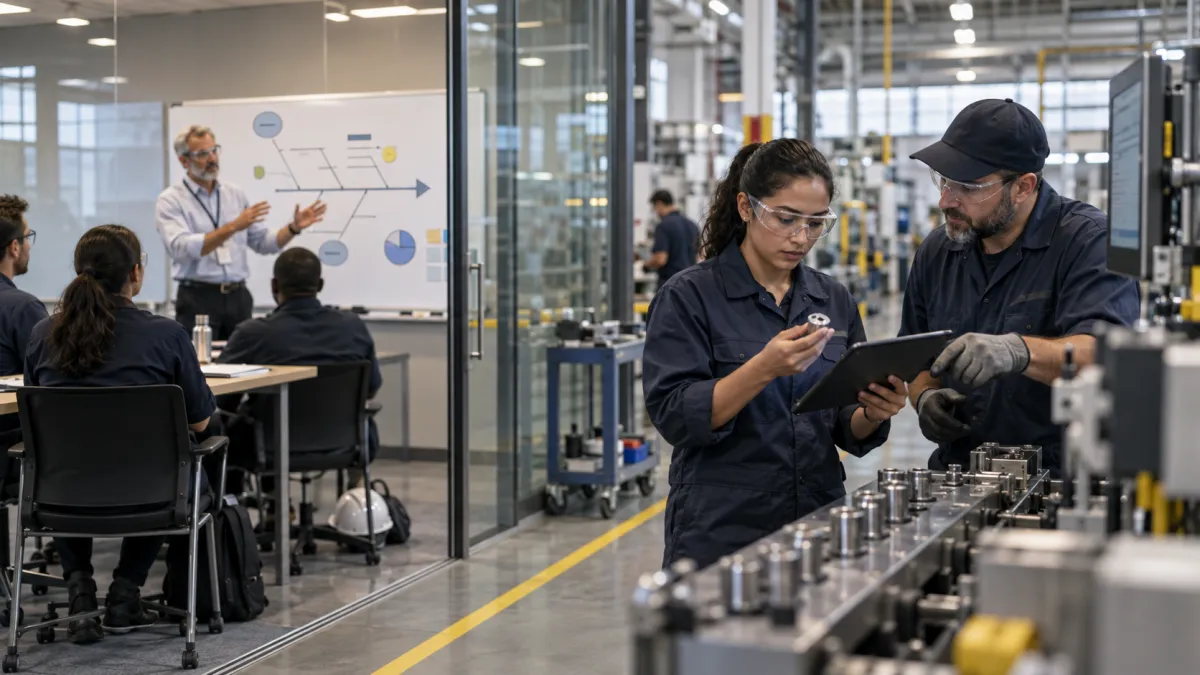
Internal or external training for engineers: which one actually works?
Neither internal nor external training wins by default. The real question is whether your engineers can adapt what they learn to your actual production floor conditions. Following a training program rigidly rarely works. Adjusting it with real-world experience is where the skill development actually happens.
Why the internal vs. external debate misses the point
You send an engineer to a three-day external course on root cause analysis. They come back energized. Two months later, nothing has changed on the floor. The same defect is recurring. The reports look a little better, maybe. But the underlying problem? Still there.
Or the opposite: you build an internal training program from scratch, document everything, and discover six months in that you've accidentally codified a workaround that should have been eliminated years ago. Now it's "the standard."
Both scenarios are real. Both are preventable. But preventing them requires you to stop asking which type of training is better and start asking what your engineers actually need to do differently on Monday morning.
That's the question worth building your training strategy around.
What external training actually gives you - and what it doesn't
External training, done well, gives your engineers three things:
Methodology exposure. Structured frameworks - 8D, 5-Why, FMEA, SPC - taught by someone who has applied them across multiple industries and failure types.
Cross-industry perspective. A quality engineer who has only ever seen your plant sees your plant's problems. External training breaks that tunnel.
Credentialed knowledge. Useful for career development, for customer audits, and for making the case internally that your team knows what they're doing.
What external training cannot give you: familiarity with your machines, your operators, your scrap history, your suppliers' actual capability, or the six informal rules that govern how your production floor actually runs. That knowledge lives inside your walls. No external trainer can teach it.
This is the gap that kills transfer. Engineers return with good theory and no bridge to practice. Without internal reinforcement - someone on the floor connecting the methodology to real situations - that knowledge has a half-life of about three weeks.
What internal training actually gives you - and where it goes wrong
Internal training has a different strength. It's specific. Your work instructions, your quality system, your containment procedures, your actual defect categories. When an operator is trained internally by someone who understands the line, the knowledge sticks because it's immediately actionable.
But internal training has a structural weakness: it reproduces what already exists. If your current process has a flaw - a measurement shortcut, a containment step that gets skipped under throughput pressure, a 5-Why that always stops at "operator error" - your internal training will teach that flaw as gospel.
We've seen this pattern repeatedly. A plant with years of accumulated internal documentation that was technically thorough and practically wrong in three critical places. No one questioned it because everyone had been trained the same way by the same people.
Internal training without external calibration breeds organizational blind spots. The longer a team relies solely on internal knowledge, the more confident and wrong they can become about the same persistent problems.
So which one should you use?
Both. Not as a diplomatic non-answer - as a functional requirement.
Think of it this way:
External training provides the skeleton. The methodology, the framework, the structured thinking.
Internal training provides the muscle. The application, the context, the real-world adaptation.
One without the other produces an engineer who either knows the theory and can't apply it, or applies a process confidently without understanding why it works. Neither type is useful under pressure. And on the production floor, pressure is constant.
If you're building or rebuilding a training approach for your quality engineers, the sequence matters: external training first for methodology, internal application immediately after. Not weeks later. The connection between the training room and the floor has to be made fast, or it doesn't get made at all.
This is also relevant if you're evaluating new hires. Knowing how a candidate handles training - whether they adapt or just follow - tells you a lot about how they'll perform when the situation on the floor doesn't match the textbook. If you're thinking about that hiring dimension, read how to choose the right quality engineer candidate before you build your onboarding plan.
Should engineers follow training content exactly or adjust it?
This is the sharper question - and it's where most training programs fail to give a clear answer.
Here's the distinction that actually matters:
Follow the methodology strictly. Adjust the application.
A 5-Why is a 5-Why. You don't improvise the logic. You don't stop at three whys because you're running out of time. You don't skip from symptom to solution because the cause seems obvious. The rigor of the method is exactly what makes it reliable - and that rigor is what an engineer should internalize completely, not adapt away.
But the way you walk a line leader through a 5-Why on a welding defect is different from how you run it in a supplier audit. The examples you use, the questions you ask, the pacing, the documentation - all of that should be adapted to the real context. That's not improvisation. That's competence.
An engineer who follows training content word-for-word without judgment isn't applying the method - they're performing it. There's a difference. Performance looks right in a classroom. It fails on the floor at 3 a.m. when a line is down and the root cause isn't obvious.
Adaptation without understanding the method is equally dangerous. Engineers who "adjust" because they find the full process inconvenient aren't adapting - they're cutting corners. That's how your quality system develops structural gaps that only appear when something goes wrong at a customer.
The real skill: knowing when you're adapting and when you're cheating
This is what separates a good quality engineer from one who looks good until there's a crisis.
Legitimate adaptation looks like this: the engineer understands root cause analysis well enough to recognize when a standard tool doesn't fit the problem structure, and selects a different but equally rigorous approach. They can explain why. They document the deviation. They get peer review.
Convenience-driven deviation looks like this: the standard process takes four hours and there's production pressure, so the engineer does a truncated version, documents it generously, and moves on. The containment is real. The root cause is a guess.
You probably know which version happens more often on your floor. The answer isn't to enforce rigid process compliance - that just drives the deviation underground. The answer is to build engineers who understand the method deeply enough to know when they're compromising it and why that's a problem.
This is exactly the challenge of holding quality under skilled-labor pressure. Fewer experienced engineers, more ground to cover, more shortcuts taken. If that dynamic sounds familiar, think carefully about how your training approach is - or isn't - building that kind of judgment.
How to structure training that actually changes behavior on the floor
Generic advice here won't help you. But these structural principles hold across most manufacturing environments:
Tie every external training module to a live internal case. Immediately after an external course on 5-Why or 8D, assign the engineer to apply it to a real open issue - not a simulation. Document both the output and where the methodology had to be adapted.
Review adaptations explicitly. Make it normal to ask: "Where did you deviate from the standard approach, and why?" If you only review the outcome and not the method, you're not managing the quality system - you're managing results.
Build internal training from verified good practice, not current practice. There's a difference. Current practice includes every workaround your floor has accumulated. Good practice is what actually works and why. Your internal training should reflect the latter, which often requires an external challenge to identify.
Rotate ownership. Don't let one person own all internal training delivery. Engineers who have to teach a method have to understand it at a different level. Rotating that role builds depth across the team.
Update training based on defect data, not schedules. If you're seeing recurring defects in a particular area, that's your signal to revisit whether the relevant training content is current and whether it's being applied correctly. Real-time quality data should drive training reviews, not the annual calendar.
On that last point - if your quality data isn't giving you early enough signals to trigger that kind of review, that's a separate problem worth examining. Catching root causes before defects escalate to scrap or customer complaints is what makes training investment visible in outcomes.
And when you find the right balance between immediate action and structured problem solving, your training program is what determines whether engineers can execute both - not choose between them.
FAQ
Is internal training better than external training for quality engineers?
It depends on what you need. Internal training is better for process-specific knowledge, work instructions, and your quality system. External training is better for methodology, structured problem-solving frameworks, and cross-industry exposure. Most effective programs use both.
Should engineers follow training content exactly or adjust it to real conditions?
They should understand the methodology exactly - then apply it with judgment. Blindly following a textbook on a live production floor will create gaps. The goal is to internalize the principles well enough to adapt them without losing the rigor.
What are the risks of relying only on external training?
Engineers return with good theory but no bridge to your specific processes, machines, or defect history. Without internal reinforcement, that knowledge decays within weeks and rarely reaches the operators who need it.
What are the risks of relying only on internal training?
Your team inherits the same blind spots the company already has. If internal knowledge was built around a workaround, that workaround becomes "the standard." External input breaks that loop.
How do you know when to adjust training content vs. follow it strictly?
Follow the methodology strictly. Adjust the examples, the sequence, and the context to match your production floor. A 5-Why template doesn't change - but the way you walk an operator through it on a stamping line versus an assembly cell does.
Here's a diagnostic question worth sitting with: if your engineers had to train a new hire tomorrow using only internal materials, would that person come out understanding the methods - or just the current procedures? The gap between those two answers tells you a lot about where your training program actually stands.
Related reading
Next step: Download the free 8D problem-solving guide