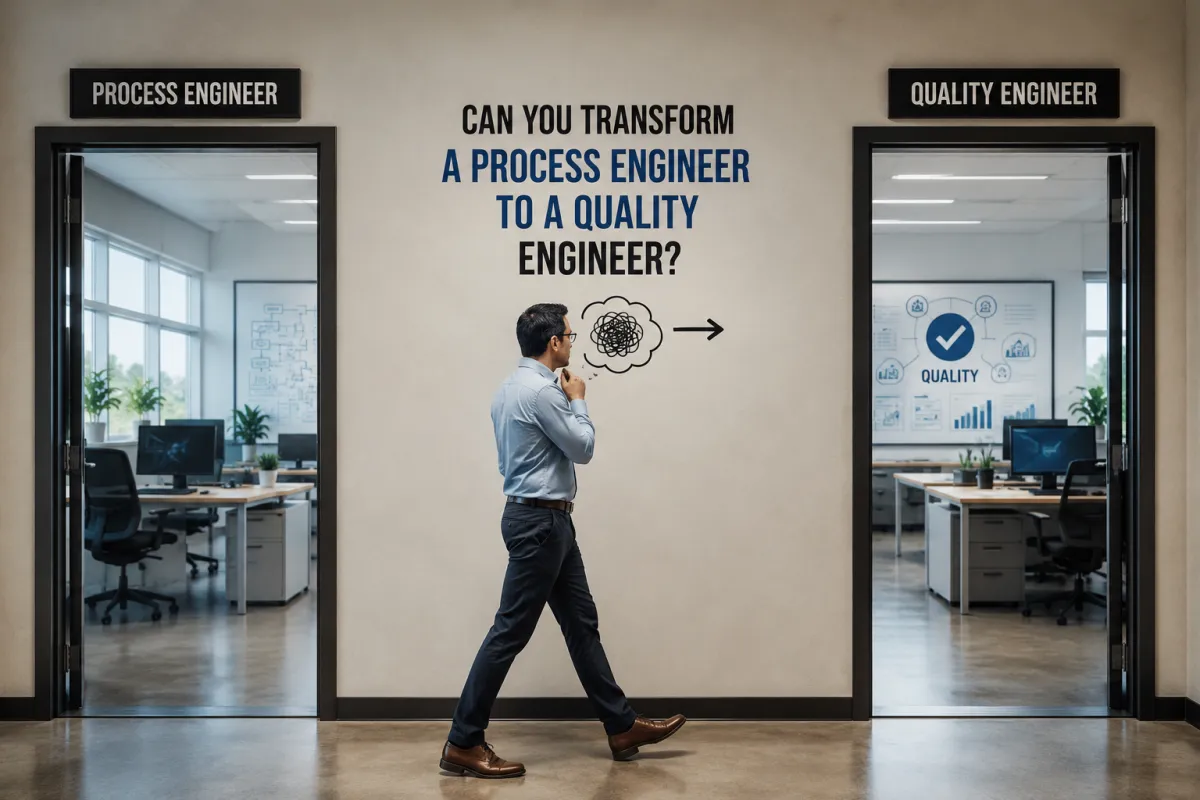
Can a Process Engineer Be a Good Quality Engineer? A Reality Check
Someone on your team just got offered a quality engineering role - or maybe that someone is you. They've spent years optimizing processes, running DOEs, and fighting scrap reduction battles on the floor. Now the question lands on the table: does any of that actually prepare you for quality engineering, or is it a completely different animal?
And underneath that question is the one nobody says out loud: are good quality engineers just born that way?
Let's cut through it.
Yes, a process engineer can become a strong quality engineer - but not automatically, and not without changing how they think about their job. The technical foundation transfers well. The mindset requires deliberate work. And no, nobody is born a quality engineer.
What Does a Quality Engineer Actually Do That a Process Engineer Doesn't?
This is where most people get the transition wrong. They assume quality engineering is just process engineering with more paperwork. It isn't.
A process engineer's job is to make the process work - hit the target, hit the cycle time, reduce waste, hit the yield. The process is the thing you protect.
A quality engineer's job is to question whether what the process is producing is actually acceptable - to your customer, to the standard, and eventually to warranty data six months, 1 or more years from now. Sometimes that means telling your own plant that their process, the one everyone worked hard to optimize, is producing parts that shouldn't ship.
That's a different conversation. And it requires a different posture.
Concretely, quality engineers spend real time on:
Customer claim handling - receiving a rejection, opening a containment, communicating with the OEM or Tier 1 before you even know what went wrong
8D reports - structured problem solving under deadline, where the customer decides if your root cause is good enough (and often they don't think it is - here's 5 reasons your customer keeps rejecting your 8D)
Supplier quality - auditing incoming material, managing supplier corrective actions, tracking supplier PPM
Warranty and field data - reading claims that come back from the field and tracing them to something that happened months ago on your line
Internal reject disposition - deciding what's scrap, what's rework, what needs a customer deviation
A process engineer touches some of these - especially root cause and scrap reduction. But claim handling and supplier quality? Usually not their territory.
What Process Engineering Experience Actually Transfers - and What Doesn't
What transfers well
If you've spent time as a process engineer in manufacturing, you already have more relevant experience than you think:
Process capability thinking - understanding Cp, Cpk, and what variation actually means is foundational in quality work
FMEA participation - if you've built or reviewed FMEAs, you understand how failure modes connect to controls, which is exactly the thinking behind root cause analysis
Work instructions and documentation - process engineers often write them; quality engineers audit compliance to them
Shop floor credibility - operators and technicians tend to trust people who understand the process, which matters enormously when you're trying to contain a defect fast
Die maintenance and tooling awareness - knowing what a worn tool looks like and how it affects dimensional output is directly useful when you're investigating a dimensional claim
What doesn't transfer automatically
Customer communication under pressure - your customer calls because they've stopped a line. You don't have an answer yet. What do you say? Process engineers rarely practice this.
8D discipline - it looks simple, eight steps, how hard can it be? Harder than it looks. The structure forces a rigor that most engineers underestimate until a customer rejects their third attempt.
Reading warranty data - field claims come in coded, aggregated, and delayed. Extracting a useful signal from warranty data is a skill you build over time.
Managing a supplier corrective action - this is diplomacy, evidence management, and technical judgment all at once. It's not the same as fixing your own line.
Containment logic - when do you sort 100%? When do you do a dock hold? When do you call a field action? These judgment calls have real consequences and process engineers don't usually make them.
Is the Mindset Shift the Hard Part?
Honestly? Yes. More than any specific skill gap.
Process engineers are trained to fix things. Something is broken, you find the root cause, you implement the solution, you measure the result, you move on. That's a satisfying loop.
Quality engineering breaks that loop constantly. You're investigating something that happened three weeks ago on a batch that already shipped. You're trying to prove root cause to someone who wasn't in your plant and doesn't believe your explanation. You're managing a containment action while simultaneously running a 8D while simultaneously updating the customer portal while your production team is asking you to sign off on the next batch.
The process engineer instinct - just let me fix it properly - collides with the reality that quality engineering runs on compressed timelines with incomplete information. For why root cause analysis is so difficult to get right, even when you have the time, read that post. When you don't have the time, it's worse.
The mindset that works in quality engineering:
Contain first, investigate second - stop the bleeding before you understand the wound
Communicate early and plainly - customers hate silence more than they hate bad news
Document everything, even the dead ends - your 8D might get audited a year from now
Treat the customer's process with the same respect you'd want them to give yours
Accept that some corrective actions will be imperfect - actually achievable beats theoretically perfect every time
None of that is impossible to learn. But it's not intuitive for someone whose professional identity is built around owning a process and making it work.
Are Good Quality Engineers Born or Made? The Honest Answer
The "born talent" framing comes up because some people seem to handle quality roles naturally - they stay calm when the customer is furious, they find the actual root cause when everyone else is chasing symptoms, they write an 8D that gets approved the first time.
What you're observing is accumulated experience, not genetics.
People who look like they were "born" quality engineers have usually been burned enough times to know what not to do. They've had an 8D rejected for a shallow root cause. They've opened a containment too slowly and paid for it with a customer audit. They've chased a red herring in a root cause analysis for two weeks and watched the PPM stay flat. Those lessons leave marks.
There are personality traits that make the role easier - comfort with ambiguity, low ego about being wrong, ability to communicate bad news without apologizing for existing. If a process engineer has those, the transition is smoother. If they don't, it's harder. But neither set of traits is fixed at birth.
What does help from the start, and what you can build toward, is a structured approach to reducing customer PPM step by step rather than firefighting every claim as if it's the first one you've ever seen.
A Realistic Transition Path: From Process to Quality Engineering
If you're making this move - or managing someone making it - here's what a grounded transition looks like:
Shadow claim handling immediately. Don't wait. Sit in on every customer call, every containment decision, every 8D review for the first 60 days. You can't learn claim handling from a procedure document.
Write a real 8D on a real problem. Not a training exercise. A live claim where the customer will actually read and respond to your report. That feedback loop is irreplaceable.
Audit a supplier. Even once. It reframes how you think about your own incoming quality processes and teaches you what good and bad supplier quality systems look like from the customer side.
Read warranty data for your product line. Understand the codes, understand the lag, understand the volume. Don't wait for someone to summarize it for you.
Ask why the last three 8Ds from your plant were rejected. If you don't know, find out. That history is your fastest education.
The process knowledge you bring in is a genuine asset. But treat it as the starting point, not the destination.
FAQ: Process Engineers Moving Into Quality Roles
Can a process engineer transition to quality engineering?
Yes. Process engineers already understand variation, tolerances, and manufacturing constraints - all critical in quality work. The main gap is mindset: quality engineering requires you to advocate for the defect, not the process.
What skills from process engineering transfer to quality engineering?
Root cause analysis, process capability (Cp/Cpk), FMEA, work instruction creation, and understanding of manufacturing flow all transfer directly. These are daily tools in quality engineering.
What skills does a process engineer need to develop for quality roles?
Customer claim handling, 8D report writing, supplier quality management, containment planning, and reading warranty data are the most common gaps when moving from process to quality.
Is quality engineering harder than process engineering?
They're different kinds of hard. Process engineering is technically demanding. Quality engineering adds political and communication pressure - you're often the one delivering bad news to customers, suppliers, and management simultaneously.
Are some people just naturally born quality engineers?
No credible evidence supports that. What looks like natural talent is usually accumulated experience with defects, claims, and corrective actions - plus a personality that doesn't panic under customer pressure.
The Honest Takeaway
A process engineer can become a good quality engineer. The technical foundation is there. The shop floor credibility is there. What takes work is the willingness to be the person in the room who says the process isn't good enough yet - and to back that up with evidence, documentation, and a containment plan rather than just an opinion.
Nobody is born knowing how to handle a customer claim at 7 AM on a Monday when you have no root cause and a line stoppage threatening. That's learned. And it's learnable - if you approach the transition with the same rigor you'd apply to a process improvement project.
Start with the basics. Get burned a few times. Document what you learn. That's how quality engineers are actually made.
Related reading
Internal or External Training for Engineers: Which One Works?
Why Is It So Difficult to Create a Perfect Root Cause Analysis?
Next step: Download the free 8D problem-solving guide