Free 8D Report Guide — 30 Pages, 5 Real Cases, Excel Template
I gave away the 8D Guide because the engineers who needed it most could never get budget for a paid one.
There is a real problem in manufacturing quality that nobody at the consulting end of the industry talks about. The training programs cost €2,000 to €4,000 per seat. The IATF auditor courses run higher. The published 8D handbooks are either academic and unreadable or written for quality directors at companies with multi-person quality departments.
The engineer who actually needs the help — the one who got handed an 8D template with no training and a deadline on Monday — has nowhere useful to go.
That is the engineer I wrote the Free 8D Guide for.
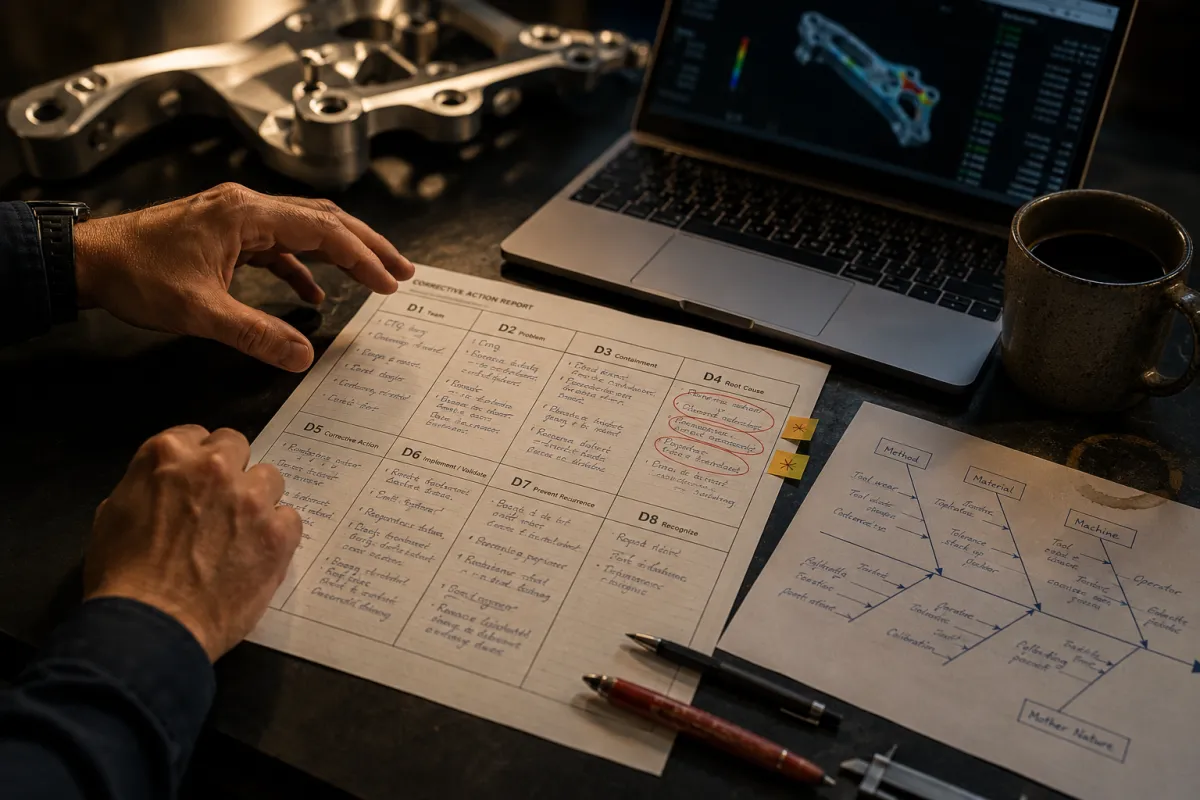
It is 30 pages. It contains five rejected 8D reports, anonymized, with the exact rejection language the customer used and the rewrite that got each one accepted. It is bundled with an Excel 8D Database Template so you do not have to start from a blank folder of PDFs. It is free, with one email field, and there is no upsell sequence after you download it.
This post is a walkthrough of what is inside, who it is for, and what it deliberately leaves out. If you read to the end and the Guide is useful for you, the download link is at the bottom.
What is inside, page by page.
Pages 1–4: The five-reason framework.
The same framework from the one of my first essay on this blog — containment, root cause, verification, evidence, tone — but with a one-page scoring rubric you can apply to your own report before submitting it. If your draft scores below 7 out of 10 in any category, the rewrite suggestions for that category are in the corresponding case study later in the Guide.
Pages 5–11: Case Study 01 — Recurring Warranty, Tier 2 Automotive.
Three rejected 8Ds in 18 months for the same defect. The customer’s exact rejection language is reproduced. The original root cause sequence is shown. The structured re-investigation that uncovered a measurement system error is walked through step by step. The rewritten 8D is included in full — every section, every chart, every piece of evidence — so you can see exactly what the accepted version looked like.
Pages 12–16: Case Study 02 — 48-Hour Escalation, Electronics Manufacturer.
A customer escalation with a 48-hour deadline and no internal quality resource available. The hour-by-hour containment timeline is reproduced. The one-page containment summary the supplier sent at the 7pm mark is included as a template you can copy. The 10-day RCA timeline that followed is mapped out with the meeting agenda for each working session.
Pages 17–21: Case Study 03 — Supplier Quality Dispute, Industrial Component.
A supplier blamed for a customer’s production disruption that the material did not actually cause. The acknowledgement-without-concession language used in the first response is reproduced. The data-driven joint investigation that dissolved the dispute is walked through. The final report that exonerated the supplier without damaging the relationship is included in full.
Pages 22–25: Case Study 04 — First-Ever 8D, Small Electronics Supplier.
A 40-person supplier with no quality department handling their first major customer complaint. The weekend RCA timeline is reproduced. The AI-assisted 5 Why investigation the plant manager ran alone is shown step by step. The 8D was accepted the same week.
Pages 26–29: Case Study 05 — Audit Finding, Tier 1 OEM.
An IATF audit finding that required a formal 8D response within 30 days. The full corrective action with the verification plan and the 90-day defect rate trend is shown. This is the case study for engineers preparing for or recovering from an IATF surveillance audit.
Page 30: The reuse library.
Reusable templates for the five most common containment scenarios. Copy, edit, send. Saves 30 minutes per escalation.
Bonus: The Excel 8D Database Template.
Bundled with the Guide. Tracks every 8D you have ever run on one tab. Active containment status on another. Customer acceptance rates on a third. Auto-generated Pareto charts. Built for a one-person quality function. Free.
Who the Guide is for.
Quality engineers and QA managers at Tier 2 and Tier 3 suppliers, especially in automotive, electronics, and industrial components.
Plant managers who were handed quality alongside operations and need a structured starting point.
Junior engineers running their first or second 8D and who want to see real examples instead of templates.
Small supplier owners with no dedicated quality department who get periodic customer complaints and need to respond credibly without hiring a consultant.
Quality engineers preparing for an IATF 16949 surveillance audit who want to see 8D examples that have actually passed.
What the Guide deliberately leaves out.
No statistical methods training. There are good textbooks for SPC, MSA, and DOE — I do not duplicate them.
No software-specific instructions. No SAP screenshots, no specific QMS software workflows. The Guide is software-agnostic.
No legal or contractual advice on warranty claim handling. That is a different discipline and a different professional.
No filler. There is no padding chapter on “the history of 8D” or “why quality matters.” Every page does work.
Why it is free.
Two reasons.
The first is selfish: the engineers who download the Guide and use it become the engineers who later send me a rejected 8D for the €79 review service. Not all of them. But enough that the math works.
The second is less selfish. I have spent twenty years watching small suppliers lose contracts because they could not get their 8D reports accepted. The technical content was usually fine. The structure was the problem. A 30-page guide is not going to save every supplier, but if it saves one small electronics company from losing a Tier 2 customer because their first 8D got rejected three times, then the math works for that reason too.
There is one email field. There is no upsell sequence. There are no “is this Guide working for you?” follow-ups. I send one email when you download — the link to the PDF and the Excel template — and that is it.
Download it.
Get the Free 8D Guide → dykeart.net/free-8d-guide
If you read it and it is useful, the AI 5 Why Tool, the 8D Review and Improvement service, and the 45-minute Quick Unblock session are the three paid tools that go further. None of them require you to start there. Most engineers I work with download the Guide first, use it on two or three reports, and only reach out for the paid services when they have a specific problem in front of them.
That is the right order to do this in.
✅ Final thought:
The Guide is the resource I wish someone had handed me twenty years ago when I was the only quality engineer in a small supplier with a customer escalation and no playbook. If it saves you one rejected report — or one lost contract — it has done its job.
Related reading
Next step: Get an independent expert review of your 8D report before you submit it