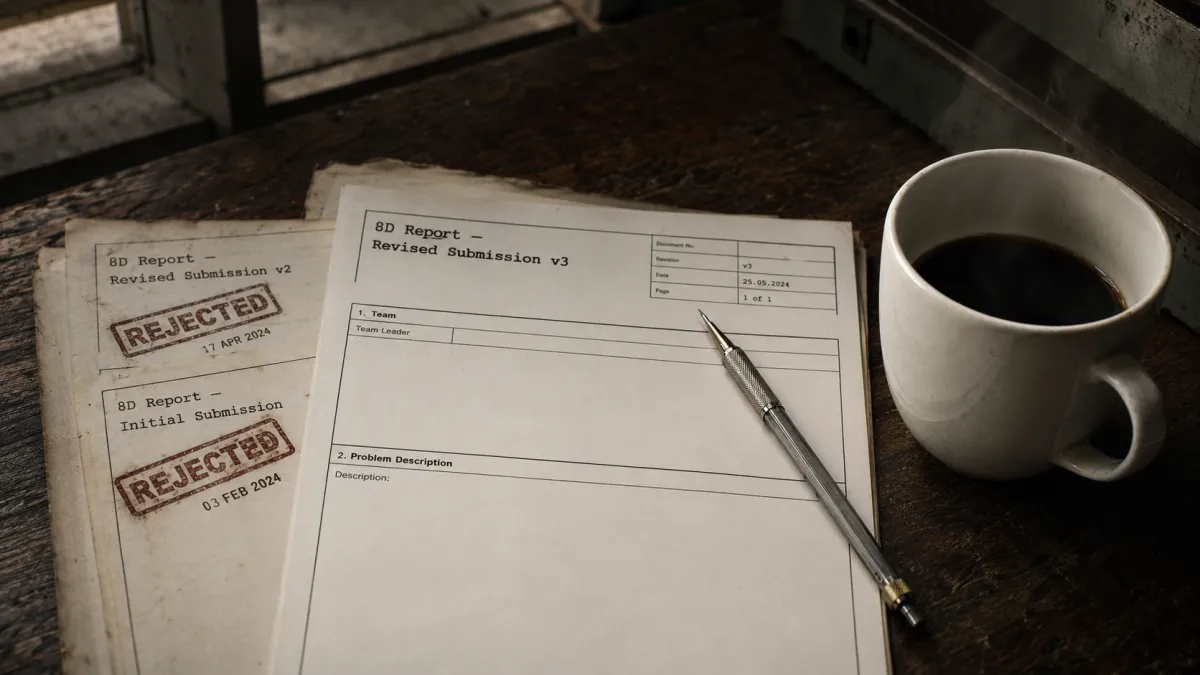
When Your Customer Has Already Said No — Reopening a Closed Quality Claim
It will be opened by someone who has already decided you do not take quality seriously. Someone who has put a small mental tag on your name. Someone who is waiting to be proven wrong.
This is the part of 8D work that nobody trains for. The corrective action is one problem. The relationship is another. And once the relationship is bruised — once the customer has formally rejected your report twice — the rules of the game change. You are no longer writing for a quality engineer who wants the line to keep running. You are writing for a quality engineer who is building a case to switch suppliers.
I have seen this scenario hundreds of times across automotive Tier 1, Tier 2, and Tier 3 supply chains. The pattern is consistent: the technical content of the third 8D is usually better than the first. The investigation is more thorough. The data is cleaner. And the report still gets rejected — because the supplier did not change the thing that mattered.
What follows is the playbook I give every quality engineer I work with when the customer has already said no. It is five moves, in order. None of them are optional.
Move 1. Repeat what they said. In their language.
The first paragraph of your reopened 8D should not be your conclusion. It should not be your new root cause. It should not be a defensive sentence about the corrective action.
It should be — word for word, in their exact language — the customer’s objections from the last rejection.
“In your feedback dated [date], you noted that our containment plan did not cover sub-suppliers, that our root cause did not address the upstream measurement system, and that our verification step did not include defect rate data for the post-corrective-action period. This revised 8D directly addresses each of those three points. The structure below mirrors your feedback order.”
Two sentences. That is all it takes to change the temperature of the conversation.
When the customer’s quality engineer opens the report and sees their own words at the top, three things happen:
They feel heard.
They believe you actually read the rejection.
They read the rest of the report looking for the answers to those specific objections — instead of looking for new things to reject.
Most suppliers skip this step because it feels like admission of failure. It is not. It is admission of attention. Those are completely different things.
Move 2. Restructure the report. Do not patch it.
This is the most common mistake suppliers make on a third submission. They take the previous rejected report, find the sections the customer complained about, and rewrite those sections in place. Everything else stays the same.
The result is a document that looks like a patch on a patch on a patch. It reads as defensive. It reads as effortful but unstructured. And it tells the customer one thing very clearly: you are still treating this as a paperwork problem instead of a process problem.
If the customer rejected you twice, the only acceptable response is a full rewrite of the report from D1 forward. New formatting. New evidence layout. New voice if you need it. The 8D number stays the same — the report itself does not.
A practical test: print the previous rejected report and the new submission side by side. If a stranger walking past your desk could tell at a glance they are different documents, you have done it right. If they look like the same report with three sections highlighted, you have not.
Move 3. Lead with the new evidence.
In a normal 8D, the evidence section sits inside D4 and D5. In a reopened 8D, the strongest piece of new evidence should appear in the executive summary — before the customer reaches D1.
The reason is psychological. The customer’s quality engineer is reading this report with one question in mind: did anything actually change since the last rejection? If the first piece of substance they see is a chart, a measurement record, or a process data table that did not exist in the last submission, the rest of the report gets read with a different set of eyes.
If you have nothing new to put on page one, you do not have a third 8D yet. You have a second draft of the second 8D. Do not submit it.
New evidence does not mean new conclusions. It means new proof:
A gauge R&R study that was not done before.
A 30-day defect rate trend that did not exist last time.
A photographic time-stamped containment audit.
A copy of the updated work instruction with the operator sign-off page.
Move 4. Pre-meet the report before you submit it.
This is the move most suppliers refuse to make. They want to submit the report and have the report stand on its own. They want the customer to read it cold and accept it on the merits.
Do not do this on a reopened claim.
Schedule a 15-minute call with the customer’s quality engineer before you formally submit. Frame it like this:
“We have a revised 8D ready to submit. Before we do, we would like to walk you through the changes from the last version and confirm we have addressed the right things. If there is anything missing, we would rather know now than after submission.”
This call does three things. It signals that you take the relationship seriously. It surfaces any remaining objections you can fix before the formal submission. And it changes the customer’s quality engineer from a reviewer into a collaborator on the next version — a stakeholder, not just a gatekeeper.
Most engineers I suggest this to push back. They say the customer is too busy. They say a pre-call will make us look uncertain. They say it is not standard procedure.
None of those things are true. Customers grant the pre-call about 70% of the time. The acceptance rate of pre-met reports versus cold-submitted reports — in my own data across 200+ engagements — is roughly 4 to 1 in favor of the pre-met version.
Move 5. Send it as a new document. Not a revision.
This is the smallest move on the list and the one most overlooked. The reopened 8D should arrive in the customer’s inbox as a new file with a new filename, not as a revision of the previous report.
File name format I recommend: [Claim Number]_8D_v3_[Date].pdf — not Tracked-Changes-Revision.docx. Not Final-Final-Updated.docx. A clean, dated PDF that exists as a discrete artifact in the email thread.
Behavior-wise, this matters because of how the customer’s review process works. A revision file gets opened in tracked-changes mode and read as a delta. A new file gets opened as a complete document and read for what it says. You want the second behavior, not the first.
Also: send it in a fresh email thread with a subject line that signals the change. “Revised 8D submission — Claim #XXXX — addressing your [date] feedback.” Not a reply to the rejection email. Start a new thread. The customer’s quality engineer will open it as a discrete event.
The bigger pattern: the relationship matters more than the report.
Every move above is, at its core, a relationship move dressed up as a technical move:
Repeating their language signals respect.
Restructuring signals effort.
Leading with evidence signals confidence.
Pre-meeting signals partnership.
Sending as a new document signals a fresh start.
Together, they change what the customer’s quality engineer believes about you before they have read a single technical conclusion.
In my experience reviewing rejected 8Ds across the industry, the suppliers who consistently get reopened claims accepted are not the ones with the best engineers. They are the ones who understand that the 8D is a communication artifact, and that communication artifacts succeed or fail based on what the reader already believes when they open them.
The first two rejections built a belief. The third submission has one job: change the belief. Everything else follows.
If you have a rejected 8D sitting on your desk right now
Send it. The 8D Review will get you a marked-up report with gap analysis and rewrite suggestions inside two working days. I will tell you which of the five moves above your report is missing, and which two changes will move the needle the most.
The Free 8D Guide also covers the reopening playbook in more depth, with two of the case studies focused specifically on third-submission scenarios that got accepted. It is free, with no upsell sequence.
And if the AI 5Why Tool can help you find the root cause that the previous investigation missed, it is on dykeart.net. It is designed to ask the layer-by-layer question that most engineers stop one question too early on.
✅ Final thought:
A customer who has rejected your 8D twice is not impossible to win back. They are waiting for one signal that you treat quality as a process, not as a paperwork chore. The five moves above are that signal — in writing, in evidence, in voice, in delivery.
Related reading
Next step: Get an independent expert review of your 8D report before you submit it