Do companies need a quality engineer? a reality check for manufacturers
Quality Engineering in Manufacturing: Do You Actually Need a Dedicated Engineer?
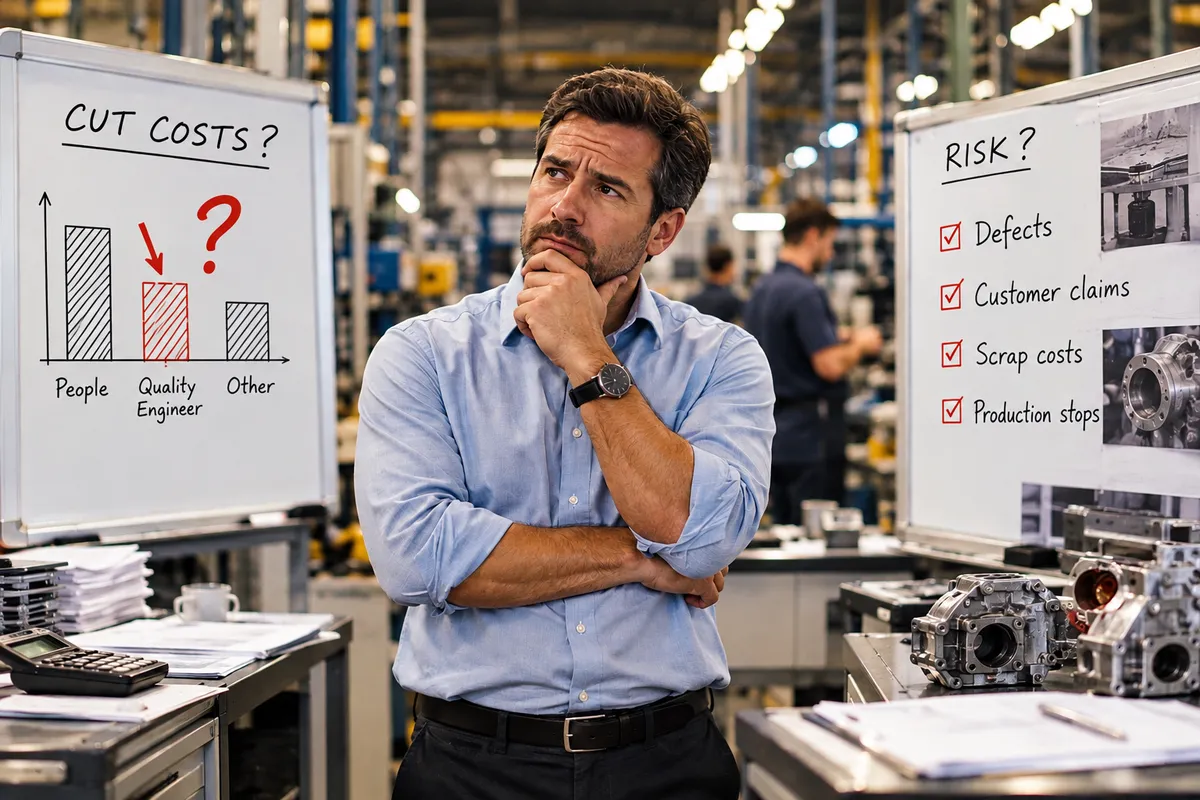
Most manufacturing companies need at least one dedicated quality engineer. Without that role, recurring defects, customer claims, and scrap costs quietly eat your margin until something breaks badly enough to notice.
This question comes up more often than you'd think. A plant manager is trying to cut headcount. A small business owner wonders if a quality engineer is overhead or investment. An operations director asks whether the process engineer can just absorb the quality workload.
Let's be direct: skipping quality engineering is not a cost-saving move. It is a deferred cost that usually comes back larger. Here is what the role actually does, when it is genuinely worth it, and what you risk when you leave the seat empty.
What does a quality engineer actually do on the floor?
This is where most of the confusion starts. People outside manufacturing picture a quality engineer as someone who walks around with a clipboard and stamps documents. That is about 10% of the job on a slow day.
The real work looks like this:
Defect investigation. When a non-conformance hits the line, the quality engineer owns finding the root cause, not just flagging the defect. That means going to the floor, talking to operators, pulling process data, and tracing the failure back to its origin.
Containment decisions. Before root cause is confirmed, you need to know which product is affected and what to do with it. The quality engineer defines containment scope, coordinates inspection, and decides what ships and what doesn't.
Corrective action ownership. Writing a corrective action is one thing. Verifying it actually changed the process and prevented recurrence is another. Most corrective actions fail at verification. The quality engineer's job is to close that loop.
Customer claim response. A customer complaint requires a structured, factual response under time pressure. For many OEMs and Tier 1 suppliers, that means an 8D report with evidence, containment confirmation, and a root cause that holds up to scrutiny.
Supplier quality management. Incoming parts fail. Suppliers push back. Someone needs to own the data, run the SCAR, and verify the supplier's corrective action. That is quality engineering work.
Process documentation and audits. Work instructions, control plans, FMEAs, and MSA studies all need to be current, accurate, and reflecting what actually happens on the floor. Internal and external audits expose gaps. The quality engineer closes them.
That is a full-time role. Often more than full-time. Splitting it across other functions because "everyone owns quality" is how you end up with no one actually owning it.
Does company size change the answer?
Yes, but not the way most managers assume.
The argument usually goes: "We are a 60-person shop. We can't afford a quality engineer." The reality check is this: a 60-person shop still generates defects. It still gets customer complaints. It still ships product that can come back. The volume of quality work scales with output, not headcount.
What actually changes with size is how the quality engineering role is structured. In a small operation, one experienced quality engineer covers everything: incoming inspection, in-process non-conformances, customer claims, supplier communication, and audit prep. In a larger plant, you have a quality team with specialized roles.
Either way, the function exists. The question is whether it belongs to someone with the skills, the time, and the authority to act on it - or whether it gets spread thin across people who have a different primary job.
If you are running lean operations and dealing with a skilled-labor gap, read our post on how to hold quality and throughput on the floor during a skilled-labor shortage. The pressure to cut quality roles during a staffing crunch is real, and so are the consequences.
Can't the process engineer just handle quality?
This is the most common workaround we see. And it almost always fails.
Process engineers and quality engineers overlap on some skills, but their default orientation is different. A process engineer is optimizing for throughput, cycle time, and yield. Their mental model is "how do I make more of this, faster." A quality engineer is looking for failure modes, escape points, and systemic risk. Their mental model is "where is this going to break, and why."
When you ask a process engineer to absorb quality work, the quality work loses. Not because the engineer is bad at their job - because they already have a full job. When the line is down or a production target is at risk, the process problem wins every time.
The result is corrective actions that stay open for months, customer claims with weak root cause analysis, and recurring defects that get "addressed" but never fixed.
What is the real cost of not having a quality engineer?
Let's be concrete. Here is what we typically see in plants that run without a dedicated quality engineer for a year or more:
PPM climbs steadily. There is no one tracking defect trends and forcing corrective action before customer escapes happen.
Scrap and rework costs rise. Without root cause ownership, the same defects recur. You keep paying to fix the same problem.
Customer claims increase. And when they do, the response is slow, poorly documented, and often rejected by the customer because it doesn't address root cause.
Audit findings pile up. Internal and external auditors find gaps in control plans, work instructions, and corrective action records. Each finding is a risk and a cost.
Supplier problems don't get resolved. Incoming quality issues keep recurring because no one is formally managing supplier corrective actions to closure.
Those costs are real and measurable. A quality engineer's fully loaded annual cost, in most markets, is recovered many times over in scrap reduction, claim avoidance, and audit compliance alone.
When is a quality engineer most valuable?
Every manufacturer benefits from the role, but here are the situations where the value is clearest:
You are a supplier to OEMs or Tier 1 companies. Your customers have formal quality requirements, claim response timelines, and audit schedules. Meeting those without a dedicated quality engineer is extremely difficult.
You are pursuing or maintaining IATF 16949 certification. The standard requires specific quality management functions to be assigned, documented, and performed by competent people. This is not optional.
You are seeing recurring defects. If the same defect keeps showing up month after month, you have a root cause problem. The fix requires structured investigation, a corrective action that changes the process, and verification that it worked. That is quality engineering work.
You handle customer complaints regularly. Responding to a customer claim with a structured 8D report, proper containment evidence, and verified corrective action takes skill and time. If you are getting more than one or two claims per month, you need someone who owns that process. See our guide on reaction to a customer claim: what to do and what to avoid.
You are scaling up. Quality problems that are manageable at low volume become serious at high volume. Getting quality engineering in place before you scale is far cheaper than retrofitting it after a major customer escape.
What to do and what to avoid when building the quality function
Do this:
Define the quality engineering role with clear ownership: claims, corrective actions, supplier quality, audits. Write it down.
Give the quality engineer floor access and authority. They need to stop a process or quarantine product without waiting for three levels of approval.
Invest in their tools. At minimum: a non-conformance tracking system, 8D templates, and documented procedures for the most common quality processes.
Measure their output: PPM trend, corrective action closure rate, open claims, cost of poor quality. Make the value visible.
Train them continuously. Quality methods change, customer requirements change, and audit standards update. Internal or external training matters. We have a post comparing internal vs. external training for engineers if you are working through that decision.
Avoid this:
Hiring a quality engineer and then burying them in documentation tasks with no floor time. The value comes from investigation and corrective action, not paperwork.
Treating quality engineering as a customer-facing role only. The internal work - defect reduction, process improvement, and scrap control - is where you actually build margin.
Making the quality engineer report to the production manager. The conflict of interest is structural. Quality engineering needs independence to be effective.
Skipping the role because "we haven't had any customer complaints lately." Silence from customers does not mean no defects. It often means the defects haven't been caught yet.
How does quality engineering connect to 8D and corrective action?
This is where a lot of companies feel the gap most acutely. A customer sends a complaint. You need an 8D report back in 10 days. If no one on your team has done a proper 8D before, or if the process for gathering containment evidence and documenting root cause is unclear, you are going to produce a weak response. Customers notice. Repeat rejections of your 8D are a serious relationship risk.
A quality engineer who understands the D0-D8 process, knows how to run a structured root cause analysis, and can write a factual, evidence-based corrective action is not a luxury. It is a basic requirement for any supplier that handles customer complaints.
If your team is still building that capability, download our free 8D report guide with 5 real cases and an Excel template. It walks through the method step-by-step with examples from actual manufacturing situations.
FAQ
Do small manufacturers need a quality engineer?
Yes. Even a 50-person shop generates enough defects, customer complaints, and documentation pressure to justify one dedicated person. A quality engineer pays for themselves in scrap reduction and avoided claims within the first year in most cases.
What does a quality engineer actually do every day?
They investigate defects, run root cause analysis, write and close corrective actions, manage supplier quality issues, maintain process documentation, and respond to customer claims. The job mixes floor work with data analysis and customer communication.
Can a process engineer cover quality engineering tasks?
Partially. A process engineer can handle some overlap, but their primary focus is throughput and efficiency. Quality engineering requires a different mindset: you are looking for failure modes, not optimization opportunities. Splitting the role usually means both jobs get done poorly.
What happens if a company has no quality engineer?
Defects recur because no one owns root cause analysis. Customer claims pile up without a structured response. Corrective actions get written and filed but never verified. Over time, PPM climbs, scrap costs rise, and customer relationships deteriorate.
Is quality engineering required for IATF 16949 certification?
IATF 16949 requires specific quality management responsibilities to be assigned and documented. While the standard does not mandate a specific job title, the functions of quality engineering must be covered by a competent, designated person.
Bottom line: The real question is not "do we need a quality engineer?" It is "are we paying for quality problems now, visibly, through a salary - or are we paying for them later, invisibly, through scrap, claims, and lost customers?" The cost exists either way. Investing in quality engineering on the floor is simply the version where you are actually doing something about it.