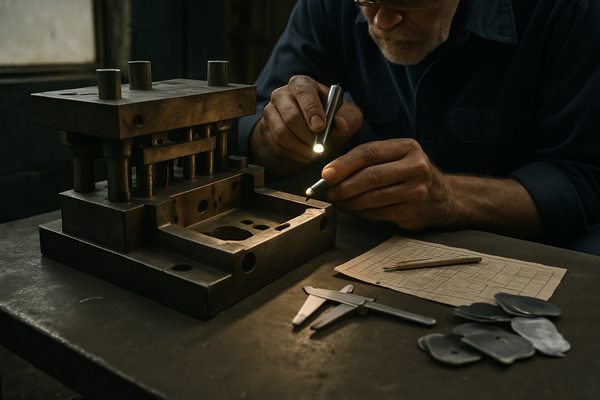
Die Maintenance Schedules and Scrap Reduction: A Quality Engineer's Reality Check
Inconsistent die maintenance is one of the most overlooked root causes of recurring scrap in stamping and forming operations. A systematic, data-driven maintenance schedule - tied directly to defect tracking and process control - is the most reliable way to reduce scrap PPM without guesswork.
Why does die condition get ignored until something goes wrong?
Here is a pattern most of us have seen more than once. Scrap rates climb slowly over several weeks. Operators adjust press settings to compensate. Quality holds a meeting. Someone orders 100% inspection. Eventually, a quality engineer pulls the die for a look - and finds wear that should have been caught two months ago.
This is not a unique failure. It is an industry norm. Dies get attention when they cause a visible crisis, not before. The problem is that gradual tool wear produces gradual defect drift. By the time your PPM spikes hard enough to trigger a formal investigation, you have already shipped questionable parts and possibly triggered a customer claim.
The goal is not just to fix the die - it is to prevent the scrap event from happening in the first place. That requires a maintenance schedule built on real data, not gut instinct or "we usually do it around this time of year."
What actually causes scrap in die operations?
Before you can build a useful maintenance schedule, you need to understand what failure modes you are actually managing. Die-related scrap typically falls into a few predictable categories:
Dimensional drift - punch and die clearance opens up as tooling wears, causing parts to grow or shrink out of tolerance gradually.
Burr formation - cutting edges dull, producing burrs that exceed print specifications. Often noticed first by assembly or the customer, not the press operator.
Surface defects - galling, scoring, or pickup on forming surfaces transfers to the part. Especially common with softer materials or when lubrication is inconsistent.
Springback variation - worn or deflected tooling changes the forming force distribution, making springback less predictable even when material properties are stable.
Misalignment - guide pins, bushings, and heel blocks wear over time. When they do, you get progressive die shift that shows up as asymmetric defects or trim edge inconsistency.
Each of these has a predictable progression. None of them appear instantly. That is precisely why a scheduled inspection approach works - if you actually follow it.
How do You build a die maintenance schedule that is actually useful?
Generic advice says "inspect your dies regularly." That is not a schedule. Let's walk through what a functional, scrap-reduction-focused maintenance plan actually looks like.
Step 1: Establish Your Baseline Data
You cannot set a meaningful maintenance interval without historical data. For each die in your operation, collect:
Total shot count since last maintenance (or since new)
Scrap rate by part number and defect type over the last 6–12 months
Any process parameter changes operators made - pressure, feed, lubrication rate
Customer complaints or PPM events traceable to that tooling
Previous maintenance records: what was done, what was found, what was replaced
If your records are incomplete, start now. Even 90 days of consistent logging gives you something to work with. Suppliers often skip this step because it feels administrative. It is actually the foundation of every corrective action you will ever write for a die-related scrap problem.
Step 2: Define Inspection Tiers
Not every inspection needs to be a full teardown. Structure your maintenance in tiers based on effort and depth:
Tier Trigger Scope Typical Duration Tier 1 - Visual Check Every production run start Visible damage, lubrication, scrap trap clearance 5-10 minutes Tier 2 - Dimensional Verification Every X thousand strokes (set per die) First-article check, burr measurement, clearance spot check 30-60 minutes Tier 3 - Full Inspection Based on shot count threshold or scrap trend Teardown, all wear surfaces measured, guides checked, cutting edges evaluated Half day to full day Tier 4 - Overhaul or Rework When Tier 3 identifies out-of-spec wear Resharpening, bushing replacement, welding, machining Varies by condition
In practice, most shops do Tier 1 inconsistently and skip Tier 2 entirely. That is why scrap spikes catch them off guard.
Step 3: Set Shot Count Thresholds - Per Die, Not Globally
A blanket "inspect every 100,000 strokes" policy sounds organized. It is not. A progressive die running high-strength steel wears at a completely different rate than a simple trim die on mild steel. Your intervals need to reflect the specific tool, material, and production conditions.
Start with your scrap history. Look for the shot count at which defects typically start appearing. Set your Tier 2 inspection threshold at roughly 70-75% of that number. That gives you a buffer to catch wear before it produces scrap - and before it produces a customer complaint.
Step 4: Close the Loop Between Scrap Data and Maintenance Triggers
This is where most programs fall apart. The maintenance schedule sits in one system. The scrap data sits in another. Nobody connects them.
Your scrap log should feed directly into your die maintenance decisions. When scrap rate for a specific part number trends upward - even slightly - that should automatically trigger a review of the associated die's maintenance status. If the die is within 15% of its next scheduled inspection, pull it early. Do not wait for the interval to expire.
This is basic process control logic. You are using output data (scrap) to adjust a process input (maintenance timing). It is not complicated. It just requires someone to own the connection between the two data streams.
What does good die maintenance documentation look like?
Documentation is the part quality engineers care about and shop floor teams often resist. The resistance is usually because the forms are too long, too vague, or never used for anything actionable.
Keep it lean. For each die maintenance event, record:
Die ID and part number(s) it produces
Shot count at time of inspection
Inspection tier performed
Findings - specific, measured where possible ("burr height 0.18mm at station 3 cutting edge, spec is 0.10mm max")
Action taken - what was actually done, not just "inspected and adjusted"
Next scheduled inspection date or shot count
Technician sign-off
When you have this data, root cause analysis becomes much faster. Instead of asking "why are we getting burrs?" you can answer: "burrs appeared at 87,000 strokes; last two overhauls also occurred around 85,000-90,000 strokes; cutting edge geometry is the degradation point." That is a finding you can act on systematically.
If you have ever struggled to write a clean 8D report for a die-related scrap problem, the lack of this documentation is usually why. Check out How to Write an 8D Report: Step-by-Step Guide with Example for the structure - but know that the data you collect during maintenance is what makes D4 (root cause) credible.
Is scrap reduction from die maintenance actually measurable?
Yes - but you have to measure the right things and be patient. Die-related scrap reduction is rarely dramatic in the short term. What you are doing is eliminating a variable that causes slow, chronic defect accumulation. The results show up in your monthly PPM trend, not in a single week's numbers.
A realistic expectation for a team that goes from ad hoc die maintenance to a structured schedule:
Months 1–2: You find more problems during scheduled inspections than you expected. This is good - you are catching them before they become scrap.
Months 3–4: Scrap rates may hold steady or dip slightly. You are building baseline data.
Months 5–6 and beyond: If the schedule is followed consistently, you should see a measurable reduction in die-attributable scrap. Many operations see 20-40% reduction in scrap events linked to tooling over a 6-month period when moving from reactive to scheduled maintenance.
For context on what realistic PPM targets look like and how defect sources stack up, How to Reduce Customer PPM in Automotive: A Step-by-Step Guide for Suppliers covers the broader picture well.
What are the most common reasons die maintenance programs fail?
Reality check: most die maintenance programs that exist on paper fail in practice. The reasons are predictable:
Production pressure overrides maintenance windows. The die is scheduled for inspection, but there is a customer order due. The inspection gets pushed. Then pushed again. This is a management discipline problem, not a technical one.
No one owns the data. Shot counts are not tracked. Maintenance records are incomplete. When scrap appears, there is no history to analyze - so corrective action stays superficial.
Intervals are arbitrary. Someone chose "every 100,000 strokes" without connecting it to actual defect history. The interval is either too conservative (wasting maintenance resources) or too long (missing the wear window).
Findings are not acted on systematically. The inspection happens, problems are noted, but the response is a quick fix rather than a real corrective action. The same wear pattern reappears three maintenance cycles later.
No feedback loop to quality data. Maintenance and quality operate in separate silos. Scrap trends do not trigger early maintenance. Maintenance findings do not update the quality team's defect map.
These are organizational failures as much as technical ones. A 5 Why on any chronic die-related scrap problem will almost always surface at least one of these root causes. That investigation is worth doing honestly - even when the answer points to a process your team controls. For a look at why that kind of analysis is harder than it sounds, Why Is It So Difficult to Create a Perfect Root Cause Analysis? is worth reading.
Where should You start if Your shop has no formal schedule today?
Do not try to build a complete CMMS-driven maintenance system in the first month. That path leads to a program that is impressive on paper and ignored on the floor.
Start with three actions:
Pick your top three scrap-generating part numbers. Identify the dies that produce them. These are your pilot tools for the new schedule.
Create a one-page die log for each. Shot count, last inspection date, last findings, next threshold. Post it at the press or in a shared folder. Assign one person to update it.
Set a 30-day review. After 30 days, look at the log. Did you hit the inspection? What did you find? Did scrap rate move? Adjust the interval based on what the data shows - not what feels right.
Simple, consistent, and connected to real output data. That is the foundation. Everything else - more sophisticated tracking, broader die coverage, integration with your quality management system - builds on top of it once the habit is established.
Frequently Asked Questions: Die maintenance and scrap reduction
How often should dies be inspected to reduce scrap?
There is no single universal interval. Inspection frequency should be based on shot counts, defect history, and material type. High-volume dies running abrasive materials may need inspection every 50,000 strokes; low-volume tooling might go 200,000+ strokes between full inspections. Let your scrap data drive the schedule.
What is the link between die maintenance and PPM levels?
Worn or misaligned dies produce dimensional drift, burrs, and surface defects — all of which feed directly into your customer PPM. When die condition degrades gradually, operators often adjust process parameters to compensate, which masks the real root cause and delays corrective action.
Can a small manufacturer realistically maintain a die maintenance schedule?
Yes, but it requires discipline over resources. A basic log, a shot counter, and a clear threshold for mandatory inspection are enough to start. You do not need a full CMMS system on day one. Consistency matters more than complexity.
What data should we collect to build a die maintenance schedule?
At minimum: shot count per die, scrap rate by part number, defect type and location, last maintenance date and action taken, and any process parameter changes made by operators. Over time, this data reveals the failure patterns that should drive your maintenance intervals.
How do we know if die wear is the root cause of our scrap?
Run a 5 Why or structured root cause analysis on recurring defect types. If the trail consistently leads back to tool condition - burrs forming at the same location, dimensional creep in one direction, inconsistent draw depth - die wear is likely the contributor. Inspect the die before assuming it is a process or material problem.
If your operation is still running on reactive die maintenance - fixing things after the scrap event instead of before - the data you need to change that already exists in your production and quality records. The schedule is not the hard part. Connecting it to your defect data and holding the line when production pressure pushes back - that is where the real discipline lives.
Try starting with the one-page die log approach above. It costs nothing and will tell you more about your tooling health in 60 days than years of informal observation ever did.
Related reading
Real-Time Quality Data: Catch Defects Before They Become Scrap
Skilled-Labor Shortage: How to Hold Quality and Throughput on the Floor
Next step: Download the free 8D problem-solving guide