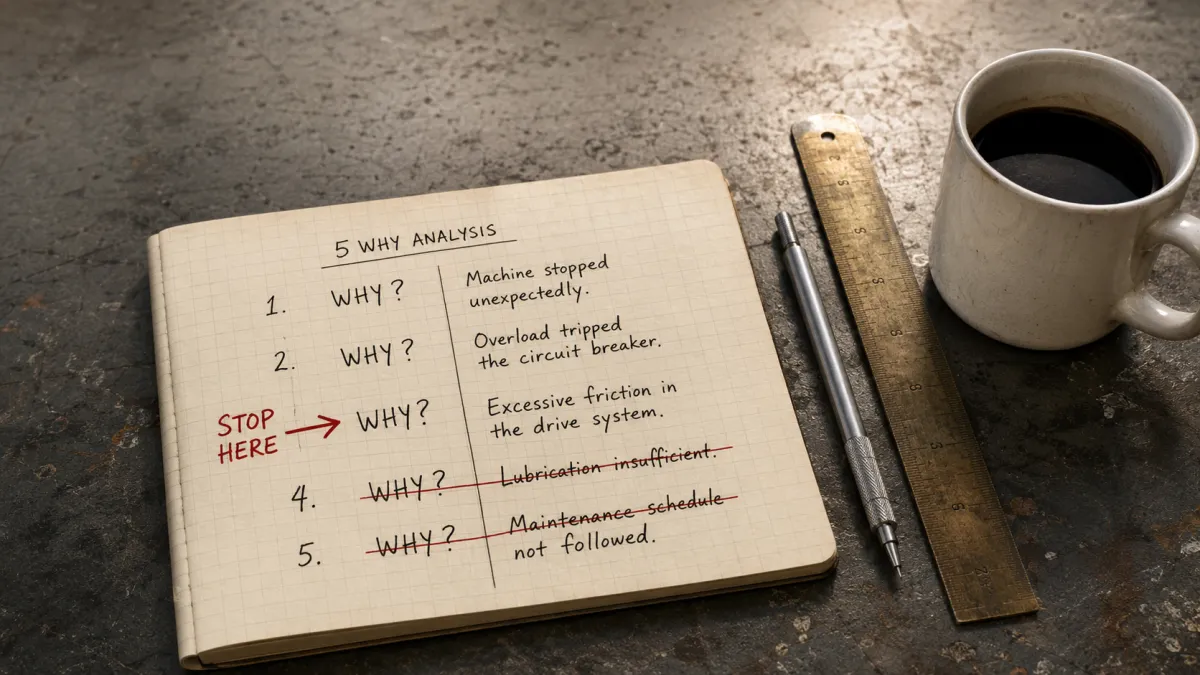
5 Why Root Cause Analysis With AI: A Walkthrough
Most engineers use it as a confession booth. They already know the answer they want. They ask why five times until they reach it.
The result is a 5 Why analysis that confirms the conclusion the supplier walked in with, instead of one that finds the conclusion the evidence actually supports. The customer’s quality engineer can spot this in two minutes. The 8D gets rejected. The engineer goes back, does another 5 Why, reaches the same predetermined answer with slightly different phrasing, and the report gets rejected again.
This post is about doing a 5 Why that actually finds the root. Not the answer you walked in with — the answer the evidence supports. And it is about using AI as the sparring partner that keeps you honest at each layer, because in most quality teams there is nobody else to play that role.
I built the DykeArt AI-Guided 5 Why Tool because I watched too many quality engineers conduct a 5 Why alone, reach a wrong answer, and have no one in the room to push back. The tool asks the questions a senior quality manager would ask if they were sitting next to you. It does not give you the answer. It asks the question you were about to skip.
The first rule: most 5 Why analyses should stop at three.
There is no rule in 8D methodology that says you must ask why exactly five times. The “five” is a heuristic from the original Toyota Production System framing. The point is to go past the symptom to the system. In practice, for most quality defects, the system shows up at the third or fourth layer.
If you find yourself on the eighth why, one of two things is true. Either you have drilled past the system and into culture, training programs, hiring practices, or HR — which are not 8D-actionable and not your scope. Or you took a wrong turn three layers ago and have been digging in the wrong direction ever since.
A 5 Why that stops at three layers, identifies a process control gap, and proposes a corrective action you can implement next week is a better 5 Why than one that goes nine layers deep and concludes “company culture does not value quality.”
A worked example: the same defect, two 5 Why investigations.
Defect: a Tier 2 automotive supplier ships brackets to a customer. 0.4% of brackets arrive with a missing weld nut at one of four mounting points.
Here is how most engineers run the 5 Why on this defect:
Why #1: Why is the weld nut missing? — Because the operator did not insert it in the fixture before welding.
Why #2: Why did the operator not insert it? — Because they forgot.
Why #3: Why did they forget? — Because there is no poka-yoke on the fixture.
Why #4: Why is there no poka-yoke? — Because it was not included in the original design.
Why #5: Why was it not in the original design? — Because the design review process did not catch it.Stated root cause: Inadequate design review process. Corrective action: update design review checklist.
This is the kind of 5 Why that gets a report rejected. Every layer is technically defensible. But the conclusion — “update the design review checklist” — does not address the defect that is still being shipped today. It is a long-term system improvement masquerading as a corrective action.
Here is the same 5 Why when the engineer is forced to challenge each layer with the question a senior quality manager would ask:
Why #1: Why is the weld nut missing? — Because the operator did not insert it.
Challenge: Did we verify this on the actual defective parts, or are we assuming? — Two of three rejected parts had the nut present but unwelded. The defect mode is incomplete weld, not missing insertion.Why #2 (revised): Why is the weld incomplete? — Because the welding cycle time was shorter than spec on the affected lots.
Challenge: Why was the cycle time shorter? Was it operator override, machine drift, or programming change? — Programming change three months ago, undocumented.Why #3: Why was the programming change undocumented? — Because the change was made by a technician without going through engineering change control.
Stated root cause: Engineering change control process was bypassed for welding cell program updates. Corrective action: lock program changes behind ECN approval at the controller level.
Three honest whys. A process control that can be put in place this month. A defect that will not recur. An 8D the customer will accept.
The difference between the two investigations is not intelligence. It is the willingness to challenge the first answer at each layer. That challenge is what the AI tool gives you when there is nobody else in the room to give it.
Where humans beat AI on 5 Why — and where AI beats humans.
AI is useful for one specific job in a 5 Why: it asks the obvious question you are about to skip because you are confident you already know the answer. It is not better than you at understanding your process. It is better than you at noticing when you have jumped a layer or anchored on a person instead of a system.
Humans beat AI on:
Knowing when to stop. A senior quality manager develops an instinct for the layer where a process control becomes feasible. That instinct is built from running corrective actions and watching them succeed or fail.
Knowing your specific process. The AI does not know that your CNC machine has a known thermal drift pattern after lunch, or that your night shift operator runs a workaround on the parts inspection because the gauge is finicky. You know that.
AI beats humans on:
Catching layer jumps.
Asking the disconfirming question.
Resisting the social pressure to land on a comfortable answer.
The combination is what works. The AI asks the question. You bring the process knowledge. The conclusion that emerges from that combination is almost always better than either alone.
Five traps that wreck 5 Why investigations.
Across 200+ 8D investigations, the same five 5 Why traps show up over and over. Here they are with the fix.
Trap 1 — You jump a layer.
You go from “operator did not insert” directly to “design review process is inadequate” without explaining the three intermediate layers. The customer sees the gap. Fix: write the missing whys out loud — even the obvious ones — and verify each one with evidence.
Trap 2 — You stop too early.
You stop at the first answer that sounds like a root cause. “Operator error” is not a root cause unless you can show why the process allowed the error. Fix: ask the disconfirming question — could a different operator make the same mistake? If yes, you are not at root cause yet.
Trap 3 — You anchor on a person.
Every layer of your 5 Why blames a different individual. The investigation becomes about who, not what. Fix: rewrite each why so the subject is the process, not the human. “Operator did not insert” becomes “insertion step has no error-proofing.”
Trap 4 — You confuse symptom with cause.
Your Why-2 is just a rephrasing of Why-1. “The weld was incomplete” and “the operator did a bad weld” are the same observation in different language. Fix: verify that each layer is mechanistically upstream of the one below it, not just verbally upstream.
Trap 5 — You skip the disproof.
A 5 Why is only as strong as the disproof of the alternatives. If your conclusion is “programming change bypassed ECN,” you also need to show that the welding tool was in calibration, that the operator was certified, and that the material was within spec. Otherwise the customer asks: how do you know the programming change was the root cause, and not one of the other three things?
Try the AI 5 Why Tool on something live.
If you have a defect investigation open right now, run the AI-Guided 5 Why Tool on it. It is built to ask the challenge question at each layer — the question a senior quality manager would ask if they were sitting next to you. It does not give you the answer. It interrupts the answer you are about to give.
Most engineers report two things after the first session:
They reached a different root cause than they would have alone.
The resulting corrective action was something they could actually implement, not a long-term system improvement they would have to lobby for.
The Free 8D Guide also includes a worked 5 Why example from a Tier 2 automotive engagement — the rejected report, the rewritten 5 Why, the corrective action that held. It is free, no upsell sequence.
And if you have a rejected 8D with a wrong 5 Why at its core, send it. The 8D Review will show you exactly which layer is off and what the corrected sequence looks like.
✅ Final thought:
The 5 Why is a discipline, not a checklist. Done well, it stops three layers deep with a process control you can implement next week. Done poorly, it goes twelve layers and concludes culture is the problem. The difference is one disconfirming question, asked at every layer.
Related reading